Second floor
Picture gallery portego
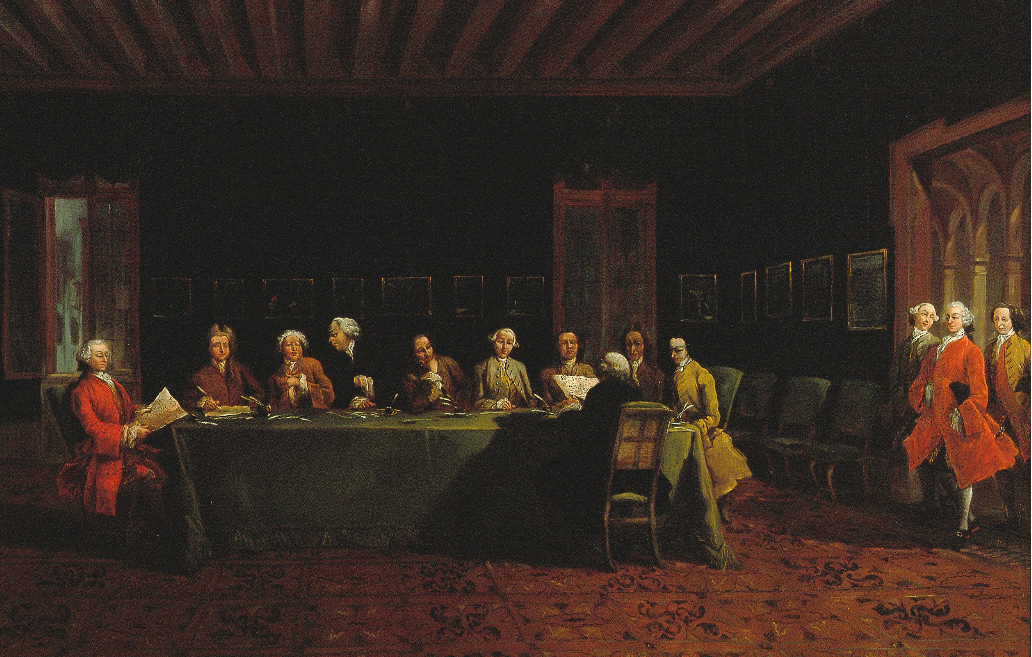
In the second-floor portego some of the most important paintings in the museum are displayed. These provide excellent examples of the various painting genres of 18th-century Venetian art: the veduta (or “view”), the landscape, the capriccio, the portrait and the figure painting.
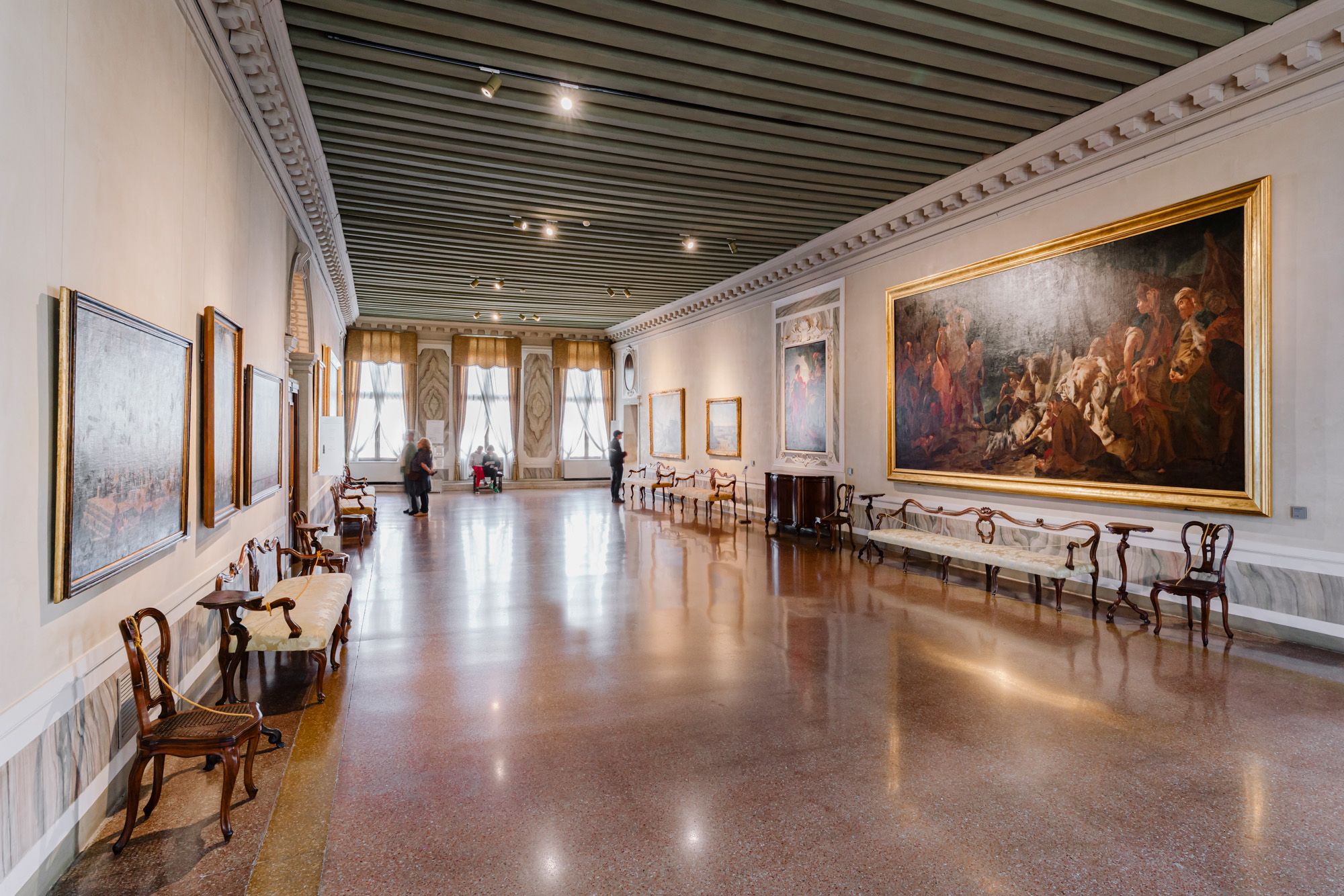
Francesco Guardi, The Dutch Diplomatic Meeting
The Dutch Diplomatic Meeting by Francesco Guardi, a work which refers to a precise historical event, the trading agreement signed in The Hague on 27th August 1753 between the Kingdom of Naples and Holland. The painting was commissioned by Count Finocchiatti, the representative of the Bourbon sovereign, who immediately after the event came to Venice and commissioned the work. Together with the other works by Francesco Guardi in Ca’ Rezzonico such as the Foyer, the Parlatory of the Nuns, the Signboard of the Guild of the Coroneri (or rosary-makers), it forms the most important group of interiors by this artist present in a public collection.
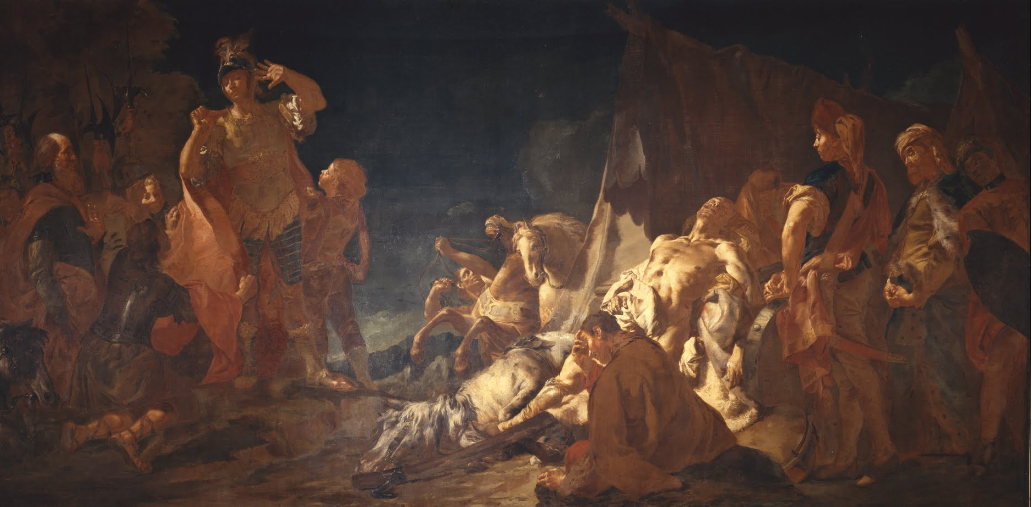
Giambattista Piazzetta, Death of Darius
The large canvas representing the Death of Darius, painted in about 1746 by Giambattista Piazzetta for the portego of Palazzo Pisani Moretta at San Polo, where it was paired with a painting by Paolo Veronese showing Alexander and Darius’ Family, later sold by the owners to the National Gallery of London. The Death of Darius is one of the great master’s most important works. All the particular features of his style, so different from that of his contemporary and rival Tiepolo, can be recognised in it. The atmosphere is gloomy and dramatic, an effect which has been emphasised by alterations in the colours which have occurred due to the priming with Armenian bole. Over the centuries this priming has absorbed and cancelled some hues, such as the pinks and light blues. Piazzetta’s rendering of faces and gestures is the result of careful meditation, in contrast to Tiepolo’s quick, free brush strokes. Piazzetta also impeccably defines the anatomy of the nude, as can be observed in the extraordinary image of the Persian king’s outstretched body.
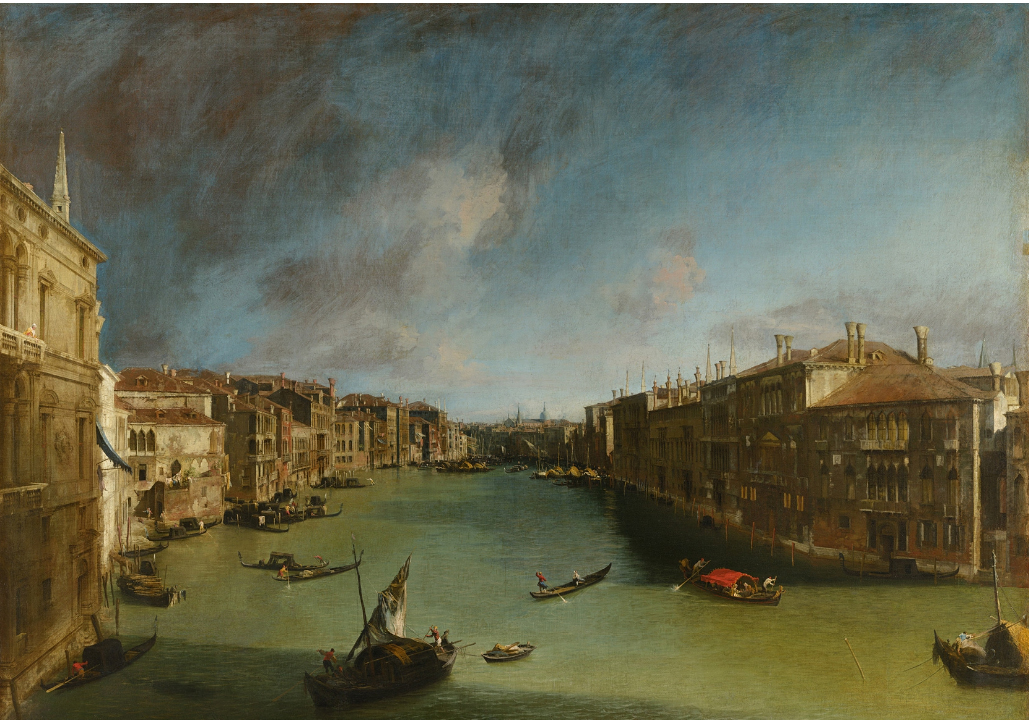
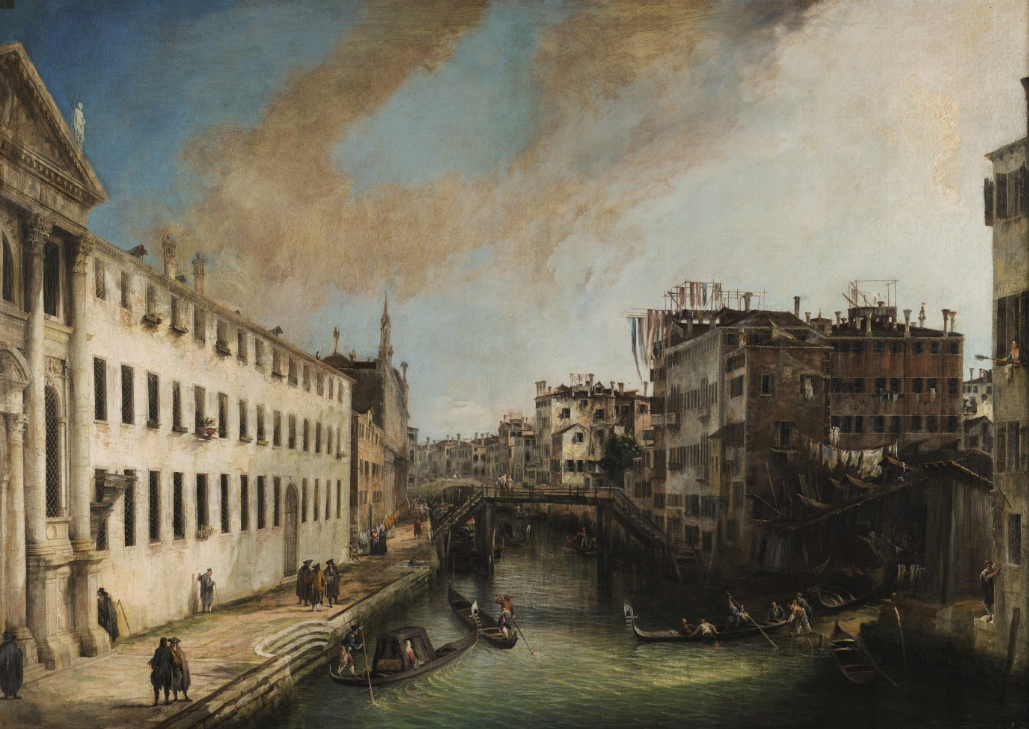
Antonio Canal known as Canaletto, View of the Grand Canal from Ca’ Balbi towards Rialto, and Rio dei Mendicanti
These are the only two views by the master which can be seen in the public collections of Venice. These paintings were originally part of a series of four, belonging to the Princes of Liechtenstein. The other two are today in the Thyssen-Bornemisza museum of Madrid). In the first painting Canaletto exalts the particular nature of Venice as a “city of water”, expanding the true width of the Grand Canal. Sunlight breaks in from the right, illuminating even the smallest element of the composition, and making even the most distant buildings distinctly perceptible. Within the perspective structure Canaletto builds up a stupefying realism which is obtained through an extraordinary use of light. Nor does he hide the signs of the pictorial operation; indeed he exhibits them bared-facedly: loaded, frayed brush strokes which offer the viewer a more ‘realistic’, more lively, interpretation of the town. Canaletto adds views which had formerly been ignored to the standard repertoire, which concentrated on the area around St. Mark’s Square. These included both the Grand Canal and little-known corners of Venice, one of which was this Rio dei mendicanti, in which the artist depicts a popular district and describes it in all its plebean beauty.
View The Grand Canal from Palazzo Balbi to the Rialto in Gigapixel >
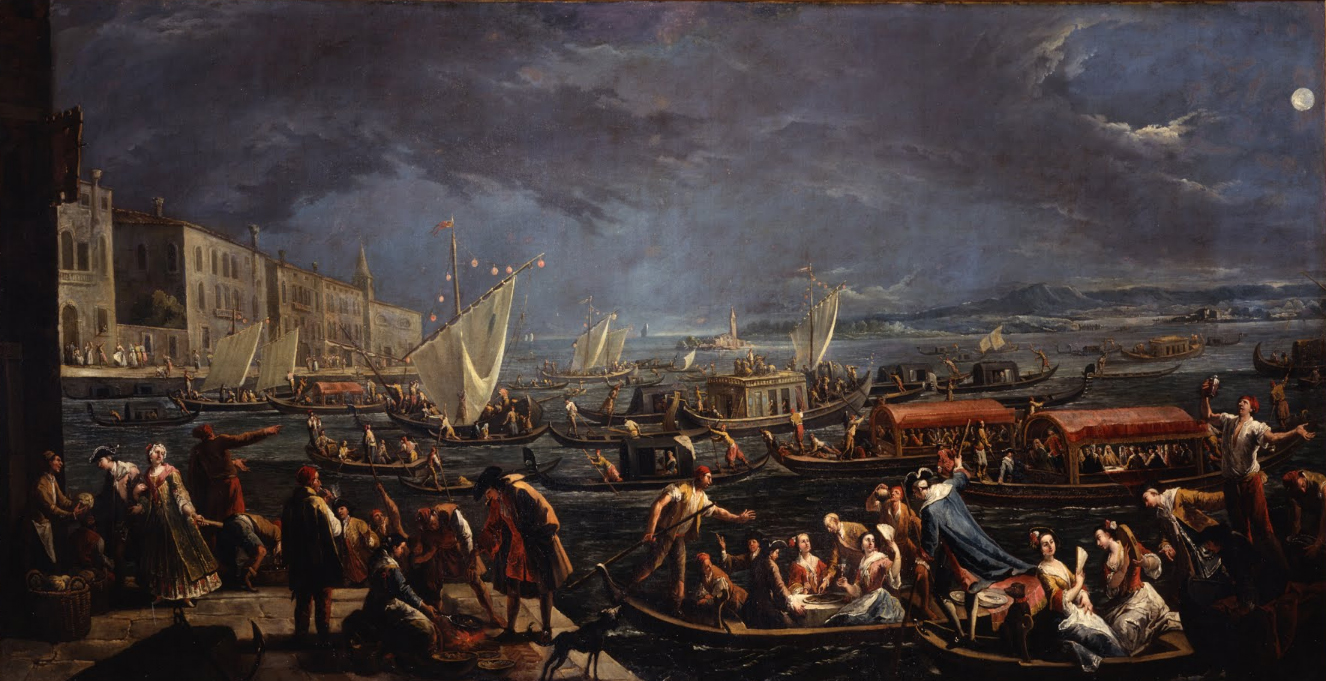
Gaspare Diziani, The Feast of St. Martha
The large painting depicts the feast, or eve, of St. Martha’s Day, a popular festival that was celebrated the night before the anniversary of the saint in front of the eponymous church located at the westernmost end of Zattere. It is a unique example in the production of Gaspare Diziani, whose work can be admired in the palace also in the frescoed ceiling of the Pastel Room on the first floor.
Throughout his career, he collaborated with lesser-known vedutisti such as Michele Marieschi and Antonio Joli, contributing charming staffage figures to their cityscapes. This is, however, the only occasion on which he painted a true veduta himself, albeit an unconventional one. Without relying on the camera obscura and drawing instead on his experience as a stage designer, he created a compelling snapshot of Venetian life.
The composition frames the broad expanse of the lagoon in a telescopic view, bustling with boats and bounded by the far tip of the Giudecca and the hills of the mainland beyond. Enhanced by its nocturnal atmosphere and the vivid depiction of figures from a wide range of social backgrounds, captured in a moment of private celebration, the painting stands as one of the most convincing examples of Diziani’s prolific career, bringing to life the unique atmosphere of eighteenth-century Venice.
Galería
Giandomenico Tiepolo in Zianigo
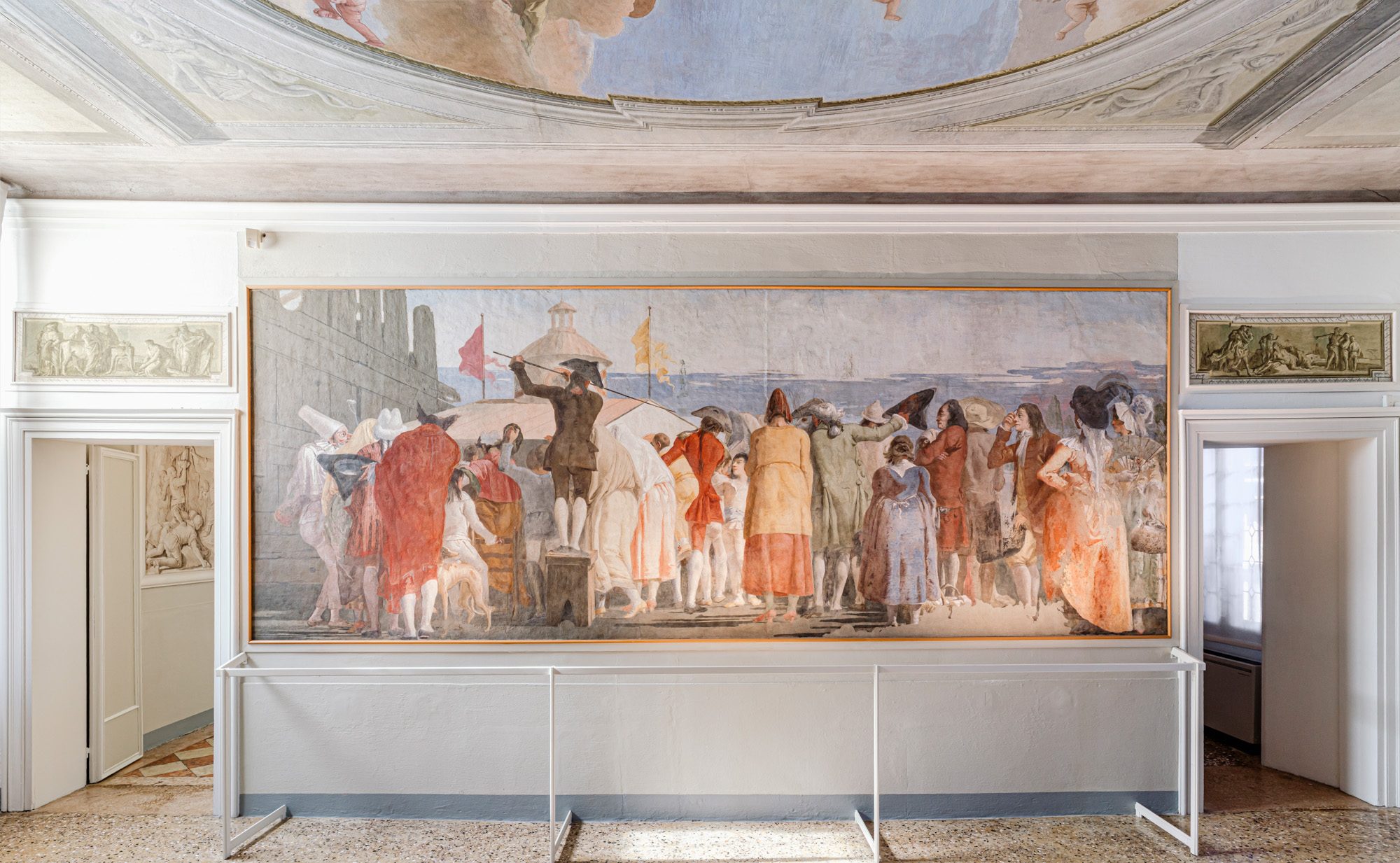
In these rooms you can admire the fresoces painted by Giandomenico Tiepolo in the family villa in Zianigo. Stripped in 1906 for sale abroad, they were purchased by the town of Venice and transferred in 1936 to Ca’ Rezzonico. Here they were hung in small rooms which wherever possible reproduce their original location. The paintings were completed over a fairly long period, between 1759 and 1797, and undoubtedly constitute one of the most fascinating, singular bodies of work in the whole of Venetian painting. They are works painted not for a client but for the artist and his family’s own pleasure, in the private context of their home. This very circumstance freed the painter from thematic and figurative conventions and allowed him to follow his own intimate nature, a propensity to sarcastic description of the world around him.
Percorso espositivo
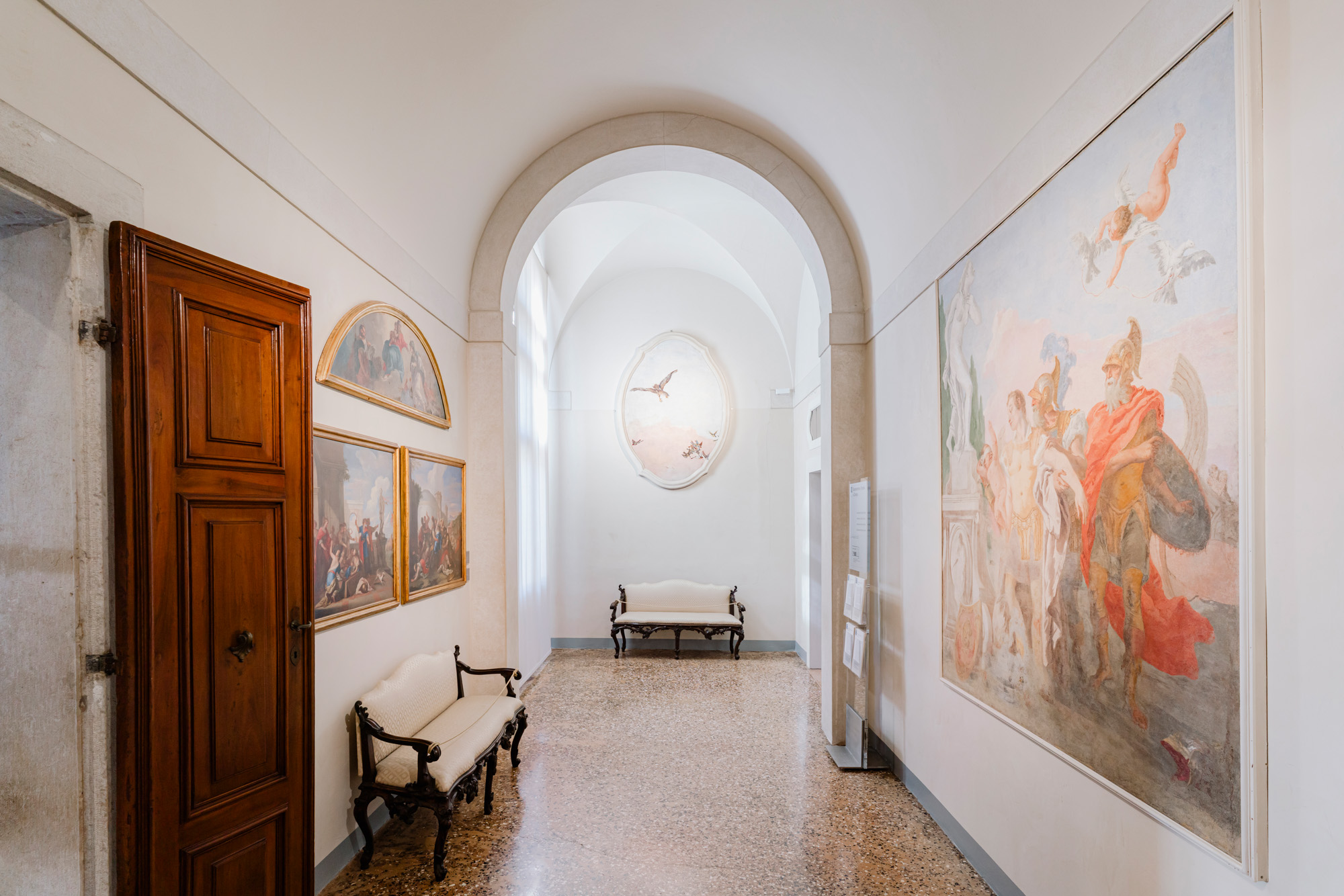
The first work in front of the door shows a scene from Torquato Tasso’s poem Jerusalem Delivered. It shows Rinaldo Abandoning the Garden of Armida, and was formerly on the ground floor of the villa of Zianigo. We are still in a figurative dimension, where both style and theme are closely linked to Giandomenico’s father’s world. The subject is connected to the grand Baroque tradition of historical painting; Giandomenico however interprets it with an ungrammatical expressiveness which corrodes its solemn, sophisticated effect. His particular nature is fully expressed on the left of the back wall, in the snapshot-like image of the Hawk Swooping onto the Flock of Sparrows in Flight. This was originally a ceiling and, instead of his father’s mythologies, Giandomenico painted a theme of limpid, natural simplicity. It is impossible not to see in this painting an allusion to the empirical culture of the Enlightenment, where the sky is the space of birds and not the home of ancient divinities.
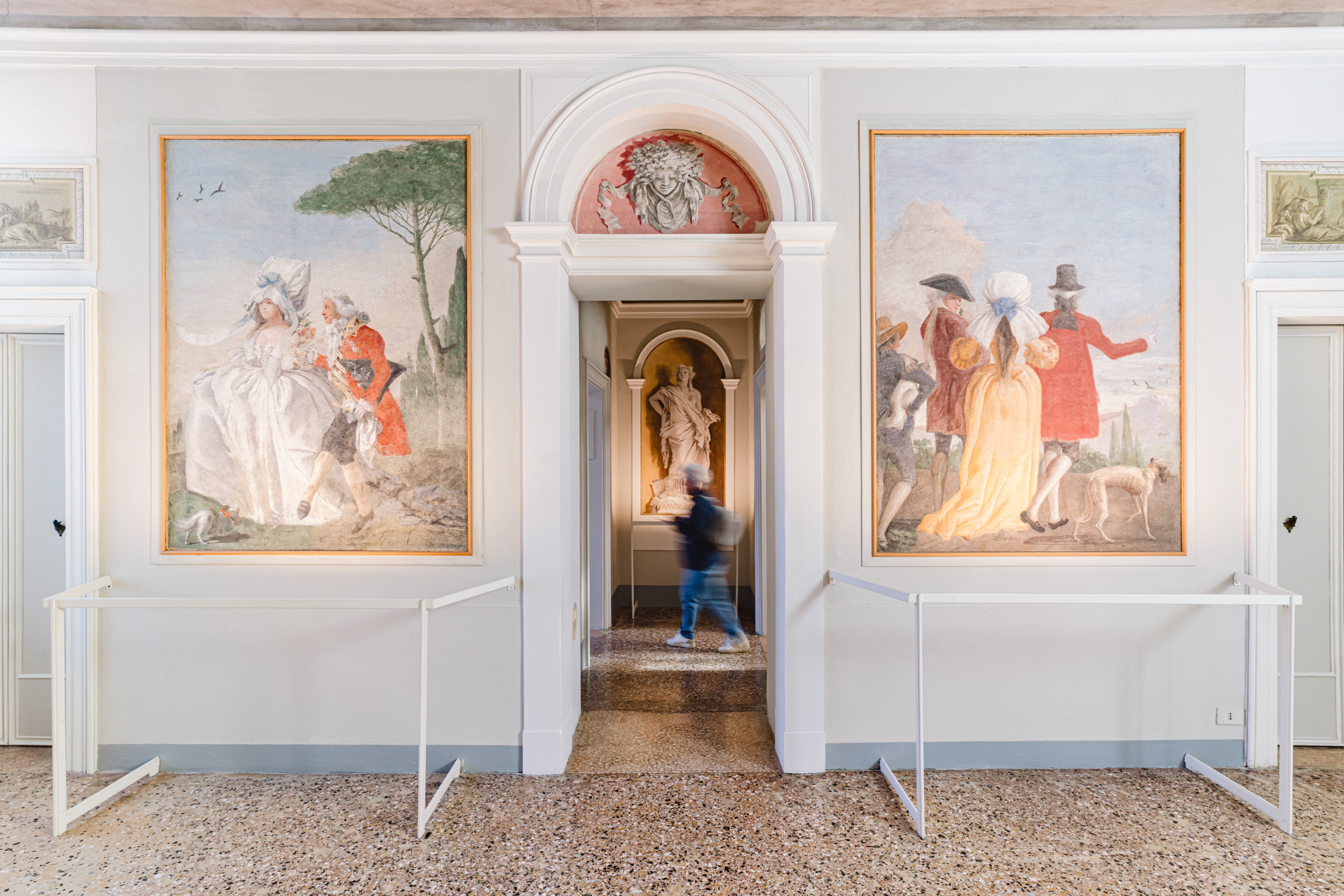
The frescoes in the next room repropose themes already painted by Giandomenico Tiepolo in his youth in the guest quarters of the villa Valmarana. After many years he gave them a new monumental form and reinterpreted them with a more mature eye which scrutinised his contemporaries with ruthless irony. The New World shows a crowd of people thronging around the huckster in his booth with the magic lantern, called in fact “New World” for the images of exotic places shown inside it. This amusement attracted not only children as was traditional, but the whole of society: common people, peasants, the middle classes; here they are all depicted lifesize from the rear in a single great anti-portrait. In this fresco, Giandomenico overturns the classic conception of representation; the scene does not present itself to the viewer but paradoxically denies itself to our scrutiny, hiding that very show which had drawn the crowd. We are not looking at a scene, rather at someone who in turn is watching what is happening. In the two minor scenes, the painter presents another theme which is particularly dear to him, that of the promenade and the dance. Here they lose that chivalrous, fashionable context typical of Giandomenico’s early small pictures. The Promenade in the villa conveys an involuntarily comic effect: the sophisticated elegance of the clothes strikes a false note when they are seen on the skinny, scraggy limbs of personages who again turn their backs on us, making a stage exit.
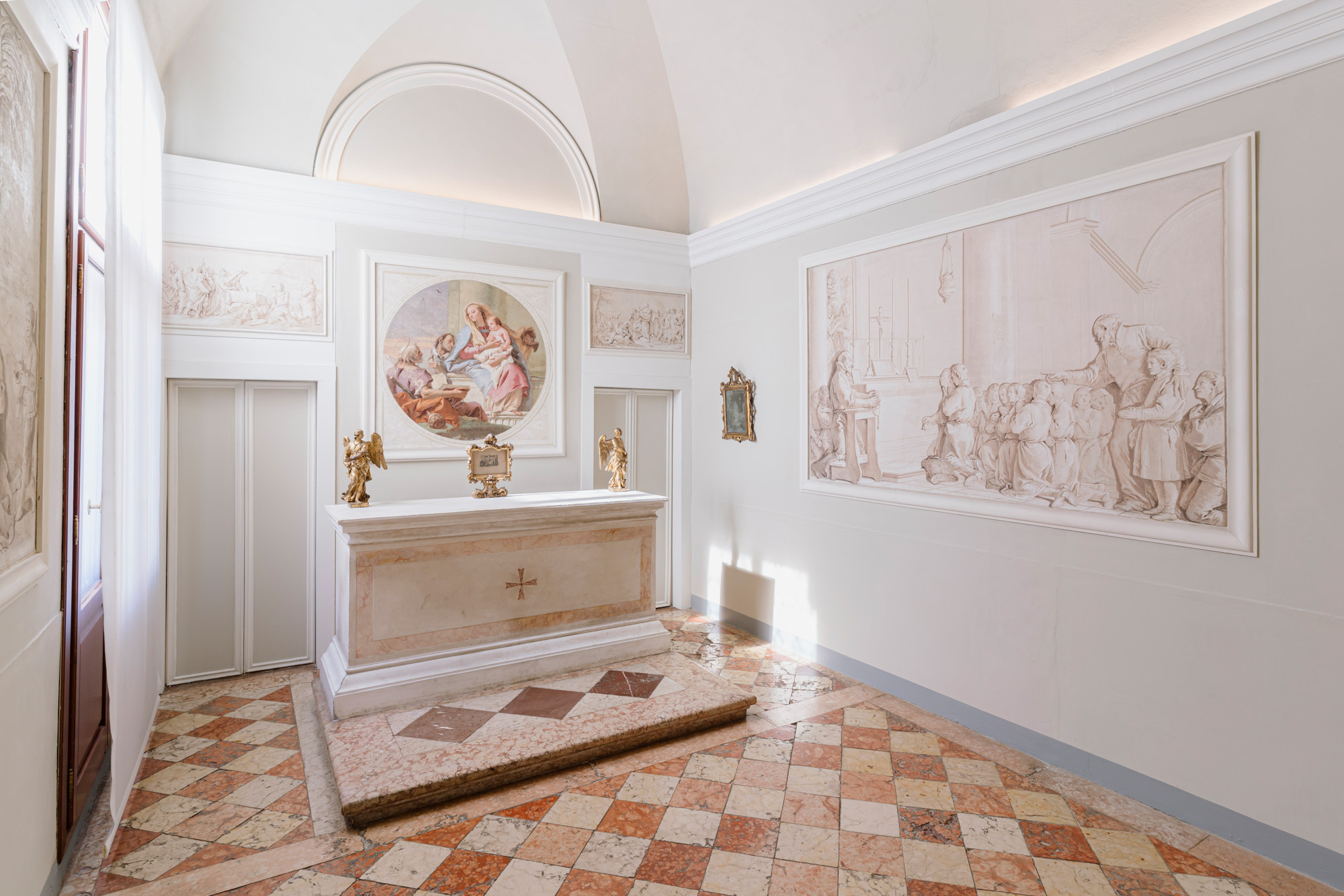
The frescoes decorating the small chapel were probably the first ones painted in the villa by Giandomenico Tiepolo. The chapel was in fact dedicated in 1758 to the blessed Jerome Miani, the founder of the order of the Somaschi to which the painter’s younger brother, Giuseppe Maria, belonged. Besides the altarpiece with the Madonna and Child adored by St. Jerome Miani and St. James the Apostle, Giandomenico painted two monochromes of the saint’s life at either side. Following his propensity for concreteness and close observation of reality, Giandomenico interpreted the two miraculous events as moments in the life of a seminary, a life veiled with melancholic squalor, spare and frugal, where there is no space for miracles.
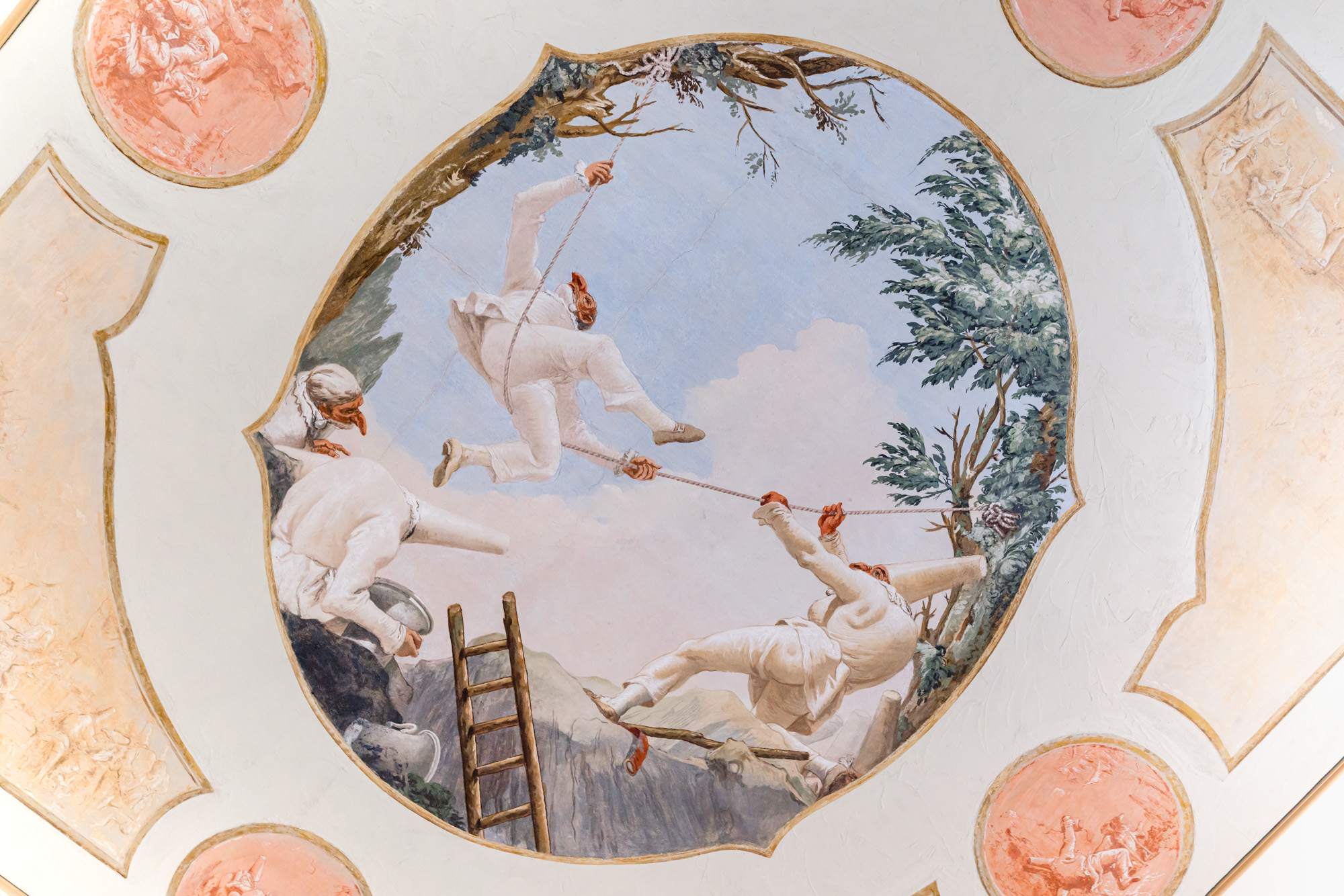
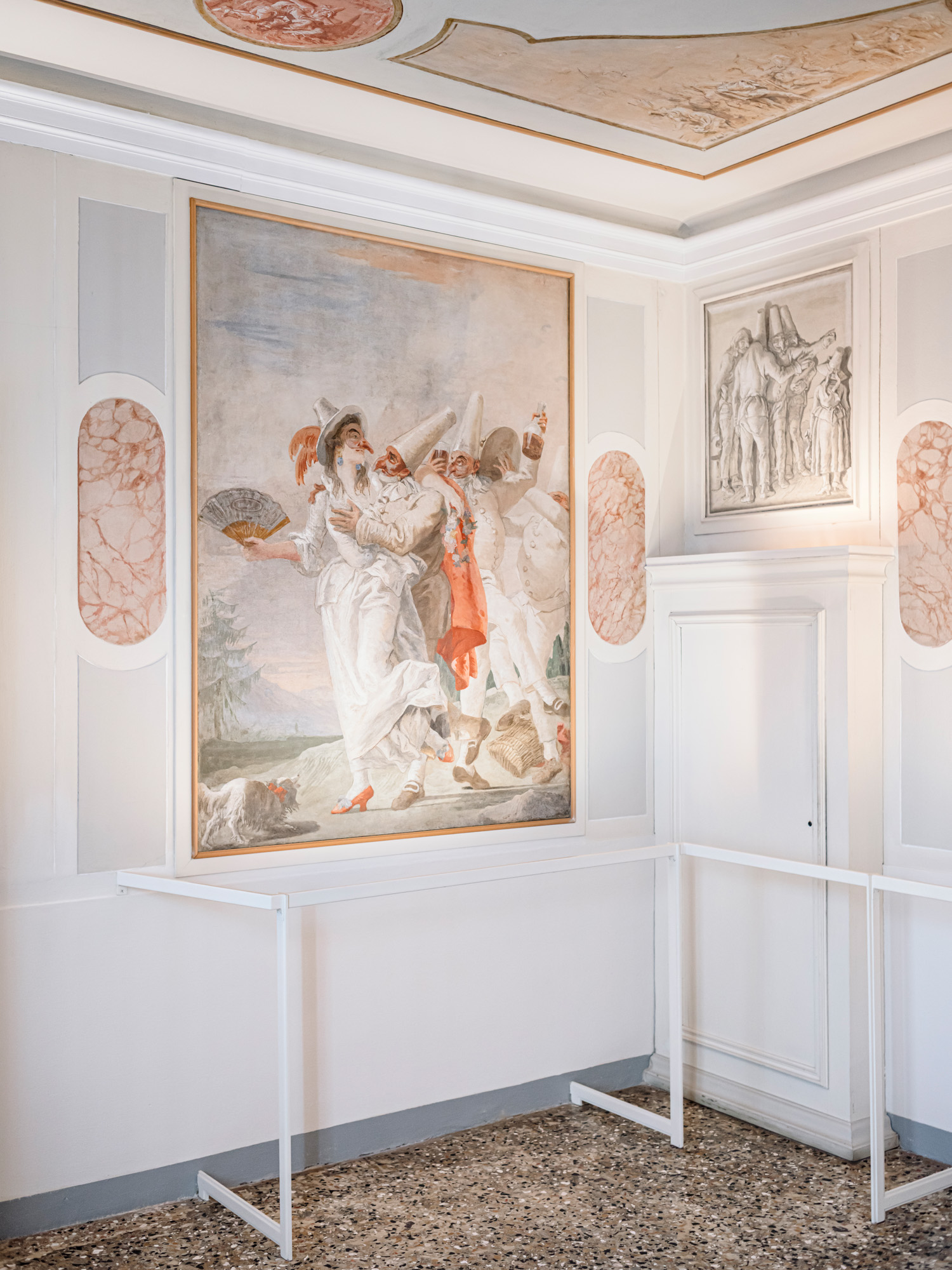
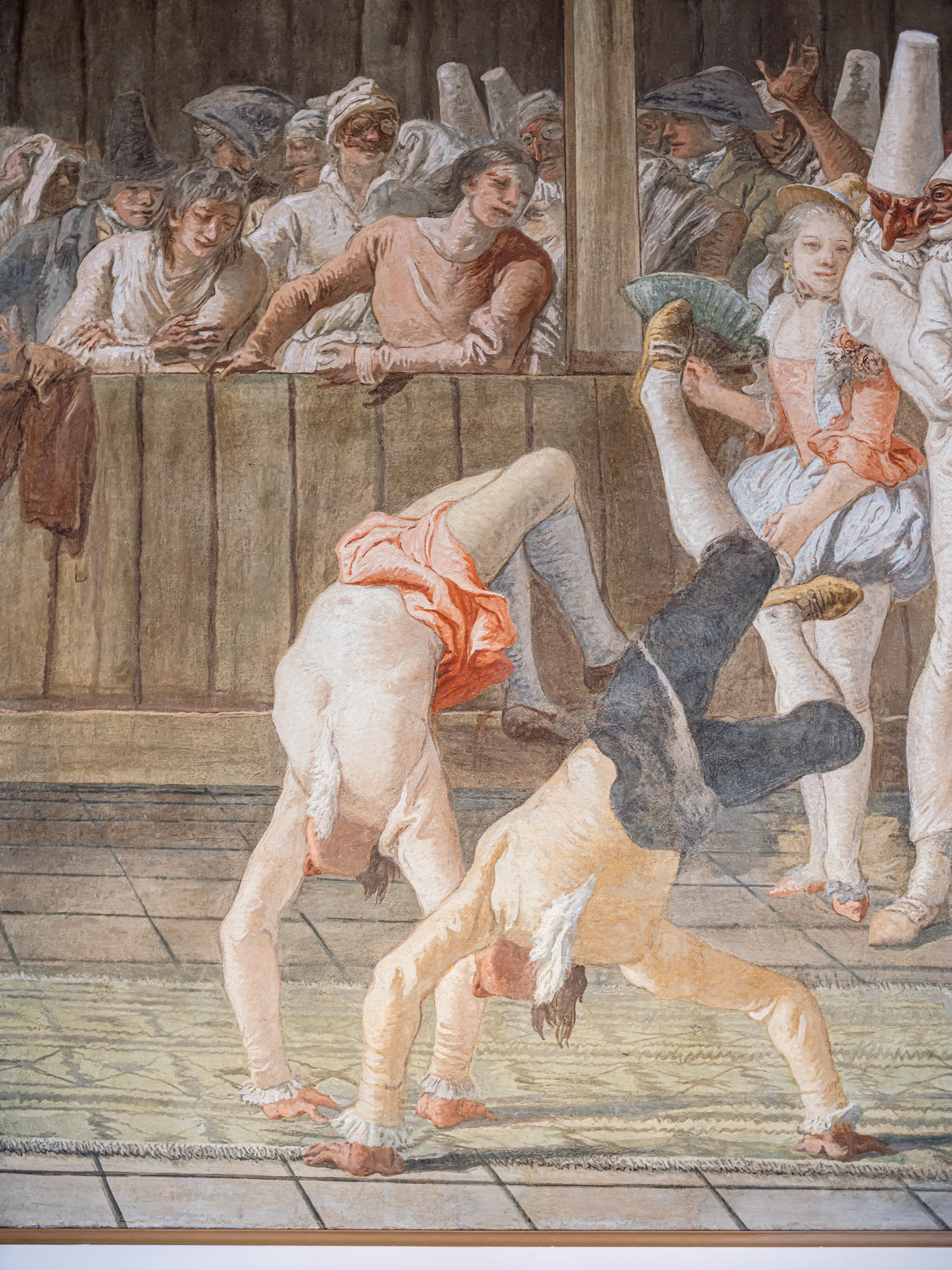
The Punchinello (or Punch) Room, which is actually a proper bed-chamber, was the last one to be painted by Giandomenico Tiepolo, and it is perhaps the most famous of the whole cycle. In contrast with the show which is denied to the viewer in the New World, a swarming multitude of figures is offered up to us here. The main character is Punchinello, the Commedia dell’Arte character who embodies the popular soul in an eternal parody of Man and his weaknesses. In the last years of his life, Giandomenico was literally obsessed by this figure, whom he painted on the walls of his house and in dozens of drawings which were then collected in an album. This album has since been dismantled and its single sheets have been scattered over various public and private collections.
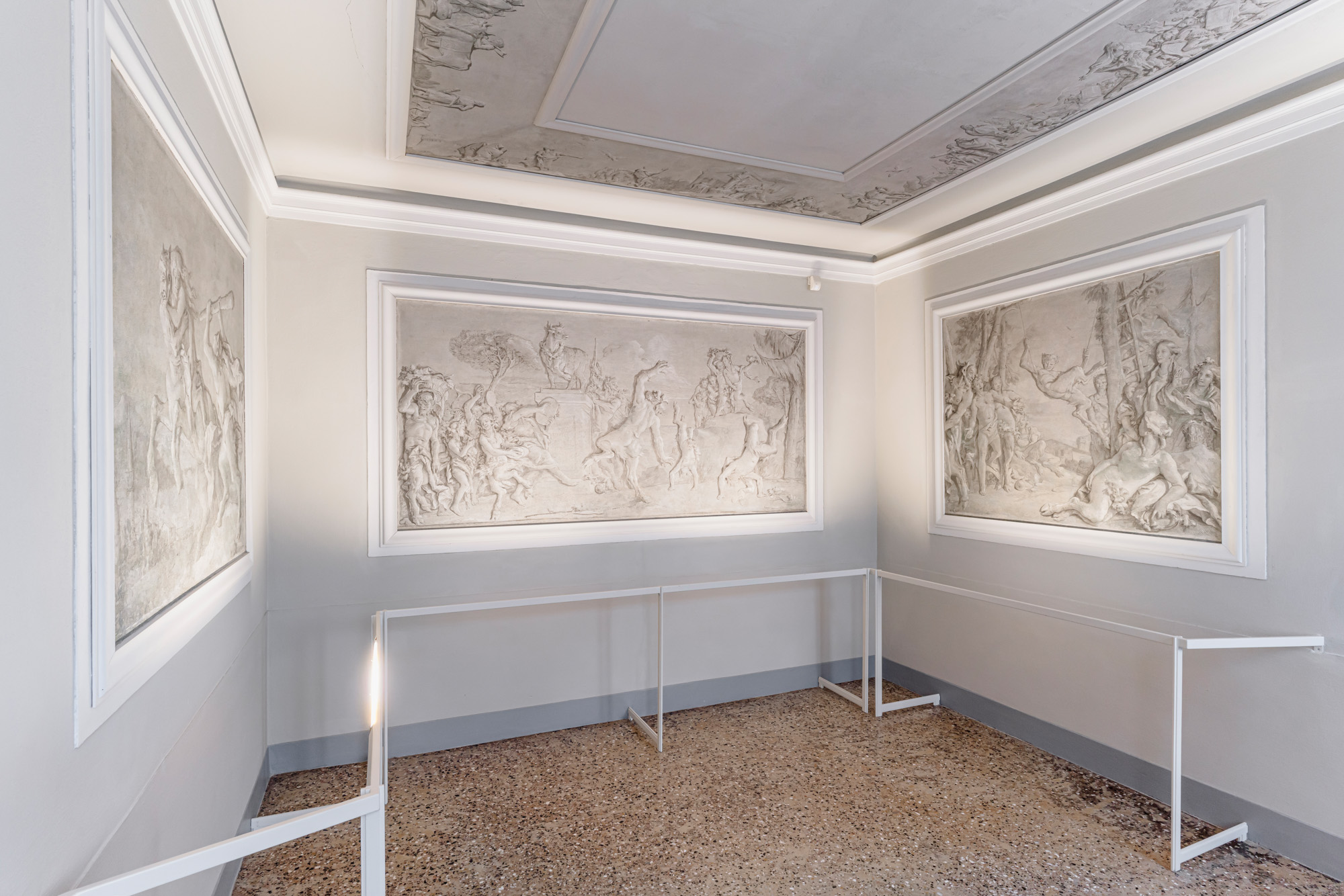
In this Commedia dell’Arte character the artist found the perfect incarnation of that irreverent, sarcastic spirit which was his own natural disposition. In the frescoes in this room, innumerable Punchinellos have suddenly emerged from the entrails of the earth up a ladder. They perform the same actions as the nobility, or mimic the protagonists of the fairytales and mythologies described by Giambattista Tiepolo. They have fun on the swing, flirt with the women during carnival, watch the tumblers’ shows, carouse and get drunk, join the promenade; in one of the monochromes they even chase away a fashionably-dressed young lady.
The future imagined by the painter is tragic-comic, terrifying and topical in its pessimism. He contrasts the fatuous New World with another brand-new world, a world populated with irreverent, rough people, a world of free, equal individuals. Here Giandomenico appears to allude to the revolutionary message then arriving from France. It may be a coincidence, but the date of the completion of the frescoes was 1797, the fatal year of the fall of the Venetian Republic.
Galería
Harpsichord Room
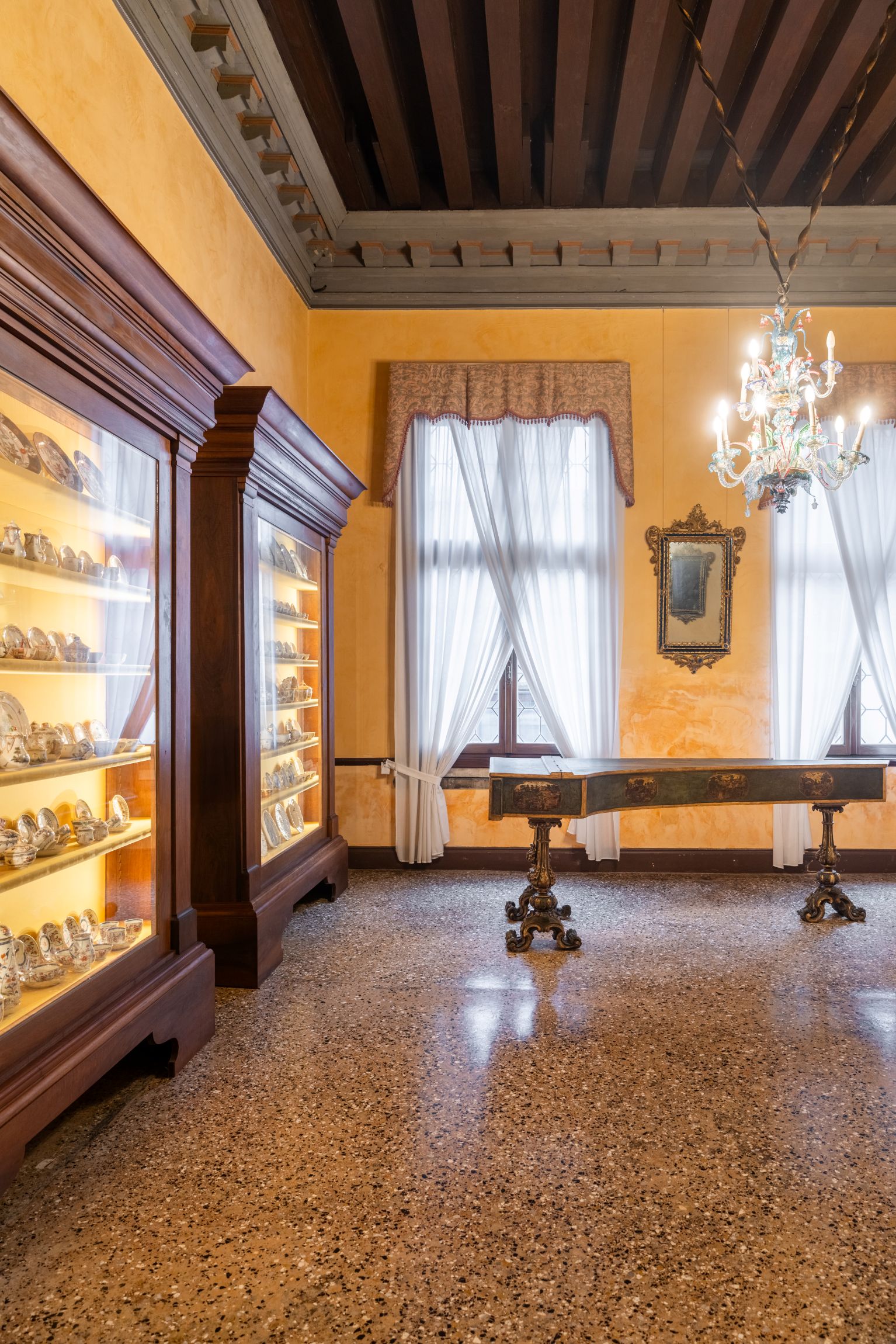
The room takes its name from the harpsichord at its centre, most probably made in Urbino in the mid-seventeenth century. A century later it was set into an ornate Venetian outer case decorated using the technique of lacca povera, a process which consists of printed cut-outs glued on then coated with a layer of protective transparent varnish, a technique also found on the fall-front chest of drawers in the same room.
The room is further devoted to the celebration of porcelain, the material that more than any other embodies the airy, brilliant forms of the Rococo. The most significant examples here come from the famous Meissen manufactory and from Venetian workshops including Vezzi and Cozzi.
Porcelain reflects shifts in fashion and taste more readily than almost any other medium. Decorative motifs range widely: from early floral patterns and Oriental-inspired designs to rocaille ornament, galantes scenes, pastoral landscapes, heraldry, and above all chinoiserie – the undisputed protagonist of the eighteenth-century table.
Room of the Parlatory
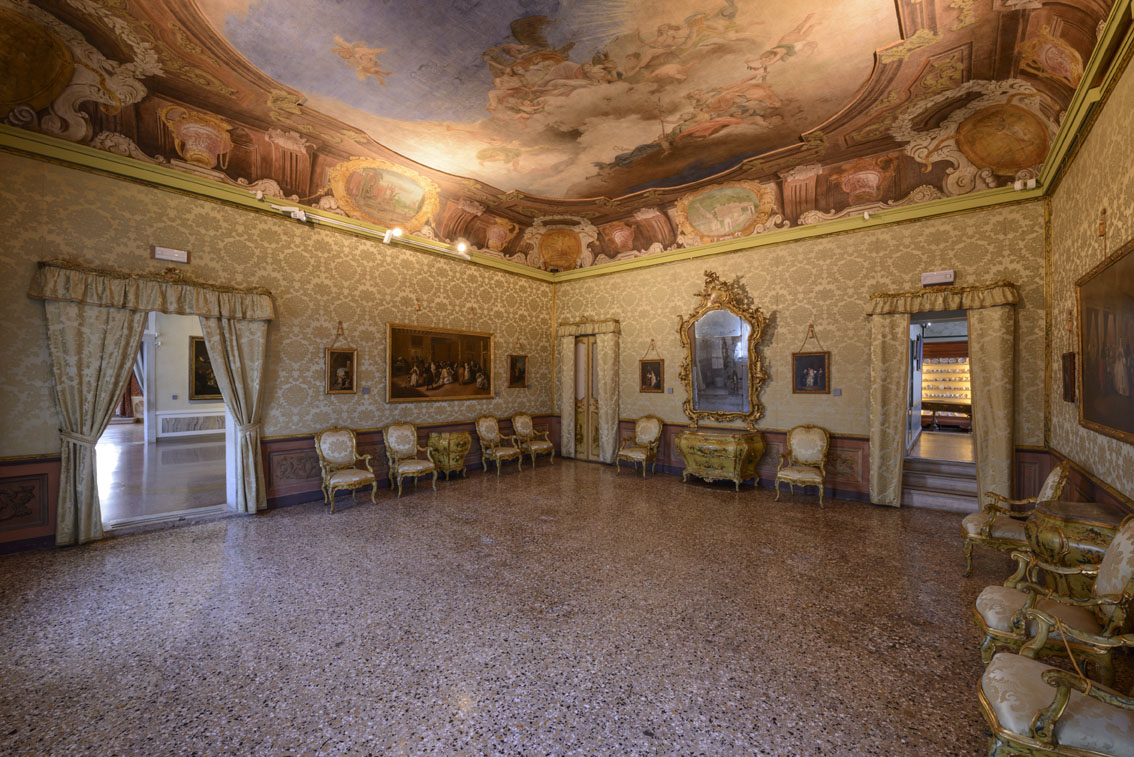
The room brings together two masterpieces by Francesco Guardi depicting eighteenth-century Venice in its most vivid contrasts. The Parlatory of the Nuns of San Zaccaria and The Foyer of Palazzo Dandolo at San Moisè belong to the painter’s early career, when Guardi worked in the tradition of Pietro Longhi’s genre painting: scenes dense with a worldly and gallant atmosphere, where masks, lovers and intrigue animate even convent life.
The two paintings mirror and oppose each other: on one side, the enclosed conventual life of the monastery of San Zaccaria; on the other, the celebrated State-run gaming house, frequented by all Venetian society during the long carnival season, captured by Guardi with an evocative power that made this the most celebrated image of that space.
On the ceiling, a detached fresco by Costantino Cedini, a late pupil of Giambattista Tiepolo, transferred from Palazzo Nani in Cannaregio. The room is completed by fine lacquered furniture in green and yellow with floral decoration from Palazzo Calbo Crotta at Gli Scalzi, a refined expression of Venetian rocaille taste.
Longhi Room
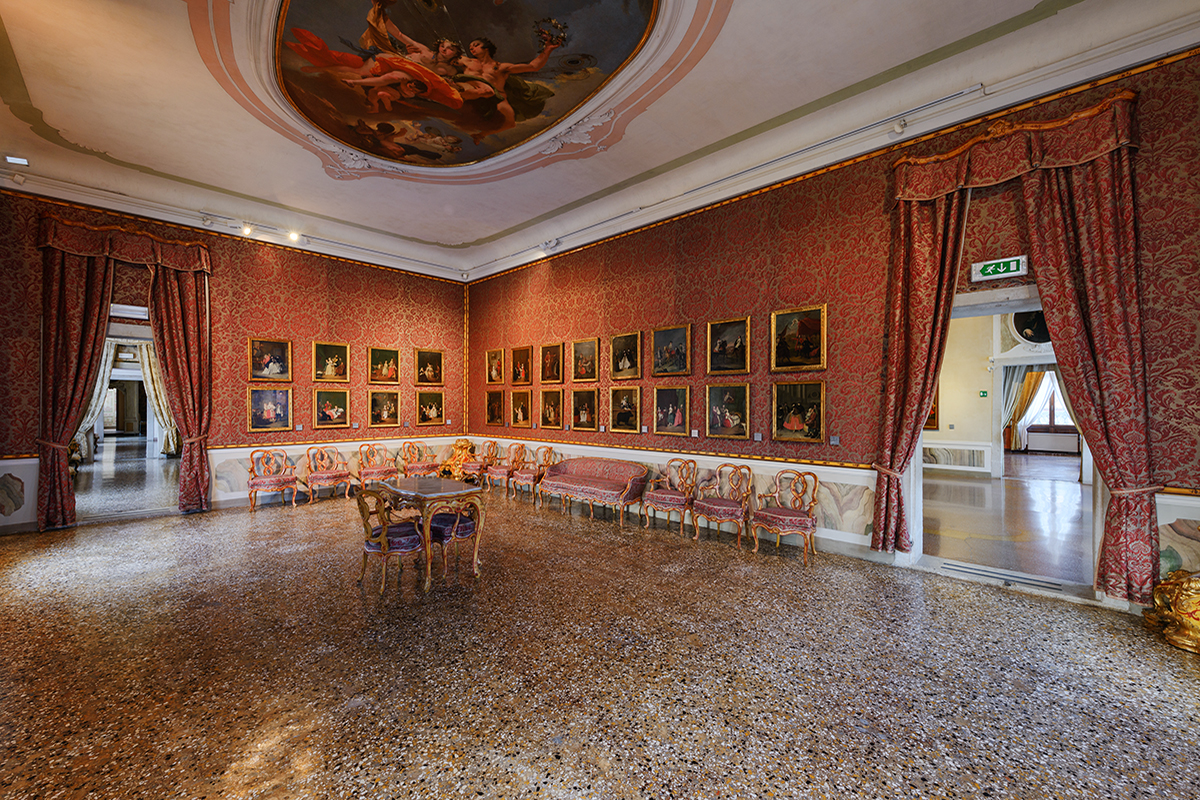
The Longhi Room stages an exceptional dialogue between two complementary visions of eighteenth-century Venice.
On the ceiling, Giambattista Tiepolo’s canvas Zephyr and Flora (1732), originally painted to celebrate the wedding of Antonio Pesaro and Caterina Sagredo, marks a turning point in the artist’s career: around 1730, Tiepolo began to bring the luminous transparency of fresco into oil painting, achieving effects of extraordinary chromatic lightness.
On the walls, a refined counterpoint: the complete works of Pietro Longhi offer a portrait of everyday Venice that Tiepolo never painted. Longhi was the first artist to depict Venetian aristocracy in the intimacy of their private lives – The Barber, Morning Chocolate, The Visit of the Bauta, The Moor’s Letter – using a delicate technique of soft colour and minute brushstrokes. The same masked aristocracy is also followed outside the home, to the booths and stages of the Carnival.
The room is completed by the yellow lacquer furniture decorated with floral motifs and red curls was originally in a drawing-room in Palazzo Calbo Crotta. The rare tub sofa is particularly curious.
The Rhinoceros
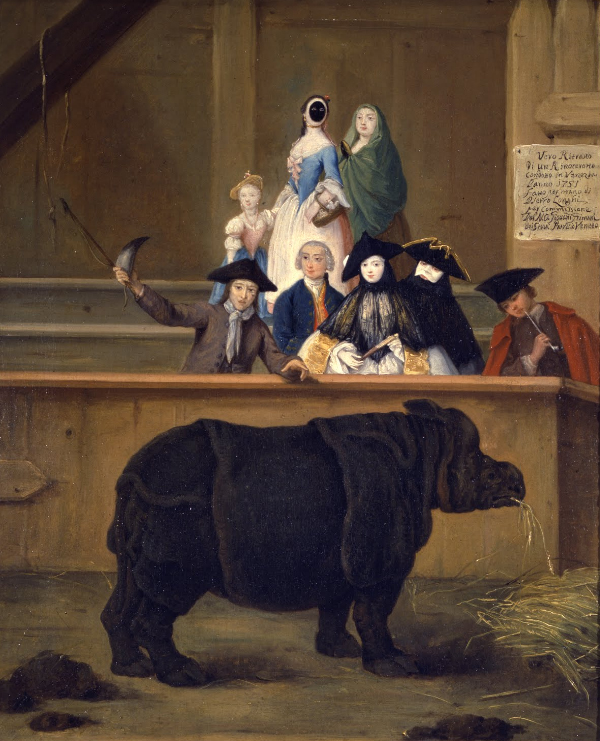
Throughout the Venetian carnival, which lasted a full three months, the various booths set up in the St. Mark’s area kept coming curious and various vendors: puppeteers, magicians, astrologers, charlatans, depicted by Pietro Longhi in many of the paintings on display here. Among the major attractions there were also exotic animals such as lions, elephants and, in this case, the Rhinoceros.
For the carnival of 1751, after a highly successful European tour, there arrived in Venice a female Indian rhinoceros named Clara. The owner, Douwe Mout van der Meer, a captain of the Dutch East India Company, had brought her with him from Bengal, soon turning her into an attraction that toured all the major European cities up to 1758, the year of her death. As stated in the notice painted in trompe l’oeil to the right of the painting, this portrait of the rhinoceros was commissioned to the artist by Giovanni Grimaldi, who had a private menagerie with many exotic animals in his villa on the mainland. Longhi made a second painting nearly identical to Grimani’s for Girolamo Mocenigo, now in the National Gallery in London. It is undoubtedly one of Pietro Longhi’s masterpieces, who succeeded in documenting the curiosity awakened by this unusual arrival in the city, magically combining intimate and the mundane aspects by placing the animal in the fascinating atmosphere of the Venetian carnival, to which it adds a fresh touch of historical truth.
At the center of the pyramidal composition, we find the commissioner of the painting himself (who was 23 years old at the time) next to his beautiful and unfortunate bride, Caterina Contarini, who was to die shortly after giving birth to their only daughter.
Green Lacquer Room
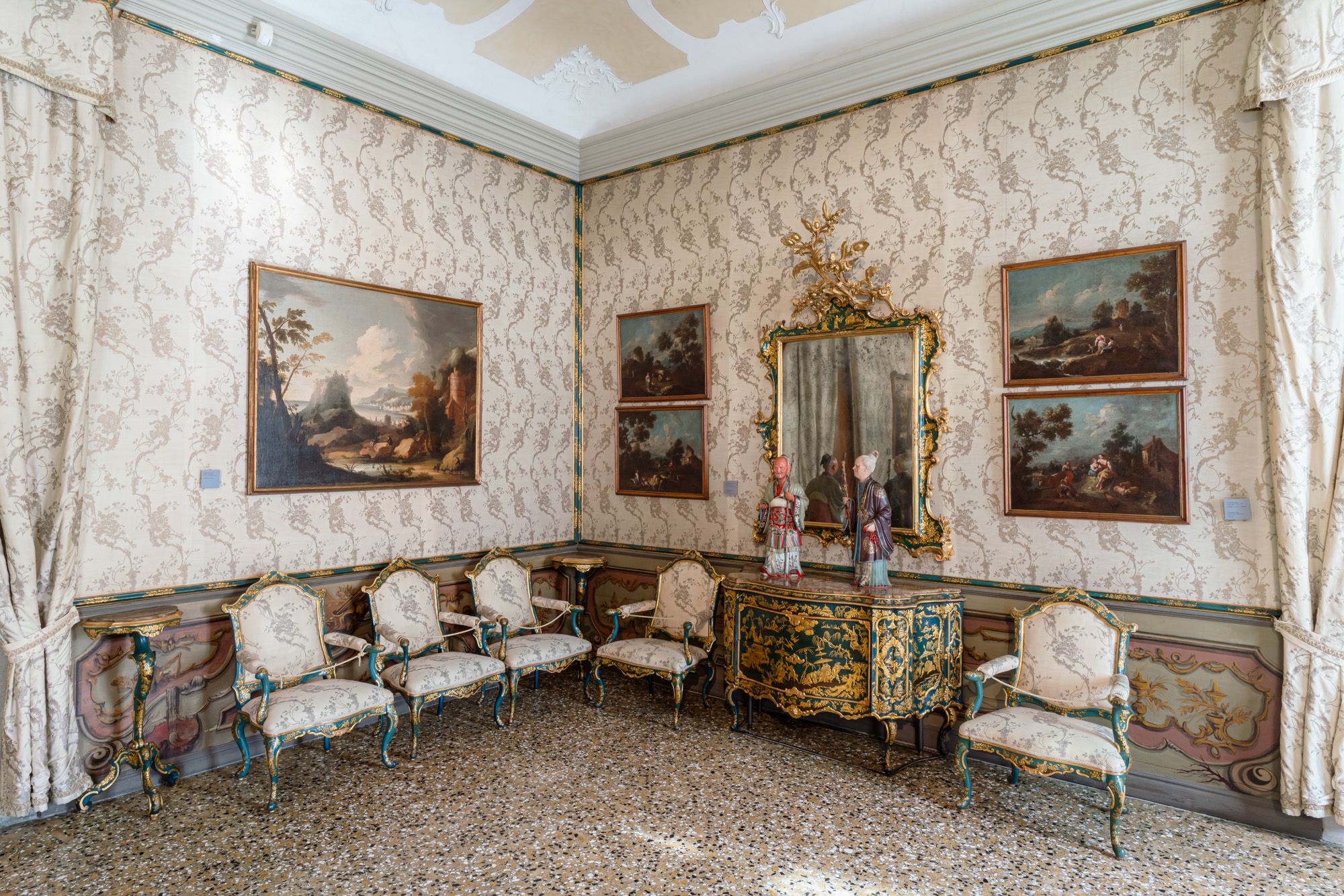
Among the most evocative rooms in Ca’ Rezzonico, the Green Lacquer Room takes its name from the magnificent emerald-green and gilded pastiglia (a kind of stucco made with plaster and marble dust) furniture from Palazzo Calbo Crotta, a masterpiece of eighteenth-century chinoiserie. This distinctly Western fusion of Louis XV forms and exotic motifs – pagodas, weeping willows, floating Oriental figures, conjured an imaginary, fairy-tale China far closer to the rococo dream than to any geographical reality.
Genuinely exotic, by contrast, are the polychrome Chinese figures in painted terracotta with movable heads.
On the ceiling, Antonio Guardi’s Triumph of Diana, from Palazzo Barbarigo Dabalà, datable to the 1760s. The elder brother of the more celebrated Francesco, Antonio is one of the most lyrical voices of Venetian rococo: in his mature works, figures dissolve into evanescent silhouettes, built from free, feathered brushstrokes that transform the composition into pure vibration of light.
Guardi Room
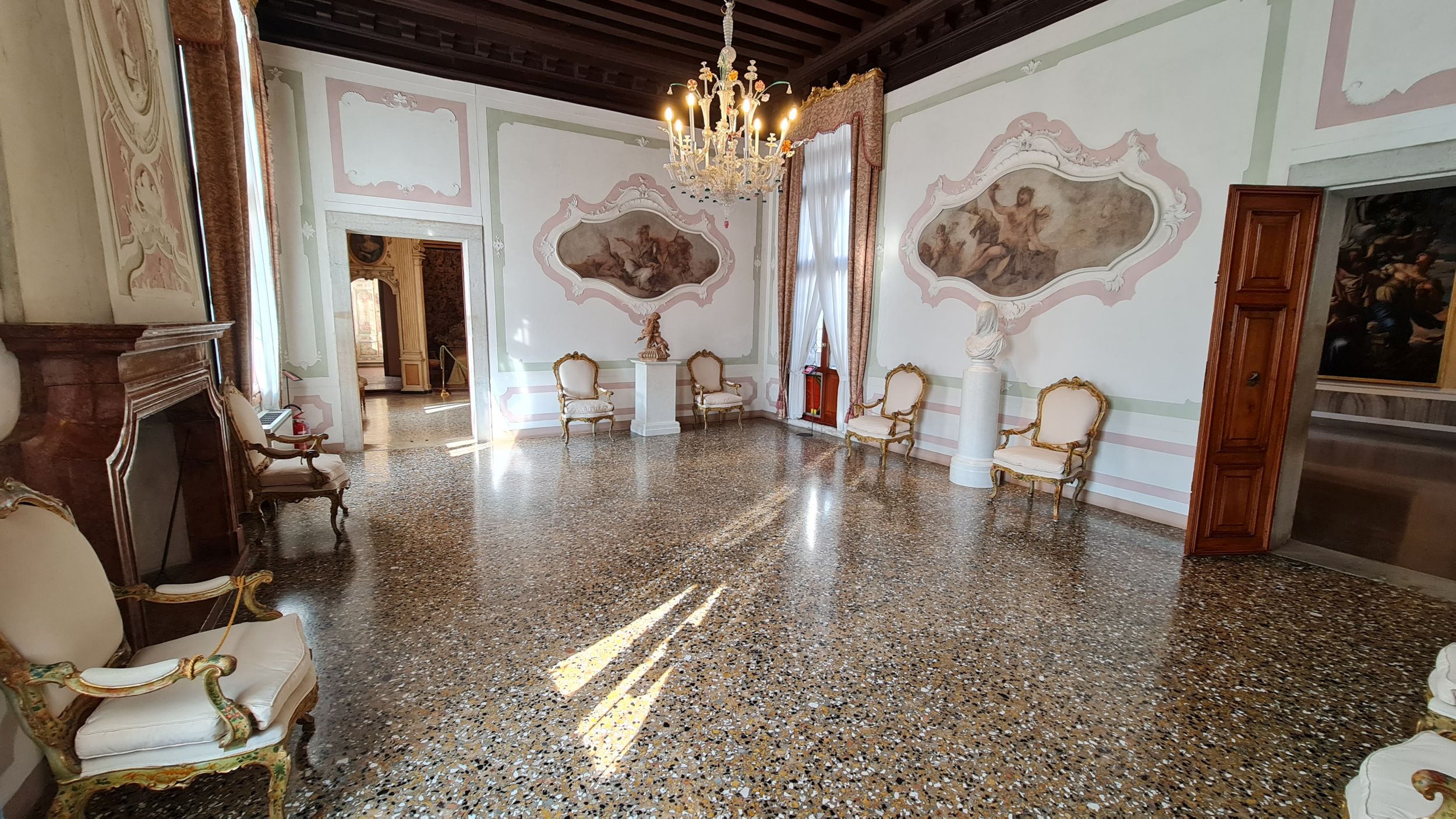
The Guardi Room houses the only frescoes by Antonio Guardi known to exist. Detached in 1936 from Palazzo Bragadin Dabalà, where they had lain hidden beneath a layer of nineteenth-century plaster, these works preserve intact the master’s poetic register – festive and light, shaped by soft, near-pastel colours and a characteristically rapid, allusive brushwork. The deities depicted – Venus and Cupid before Vulcan’s forge, Apollo crowned with laurel, Minerva seated among the clouds – appear as gentle visions far removed from the monumentality of the Baroque.
The true jewel of the room, however, is the marble bust of a Veiled Woman is the work of the Venetian sculptor Antonio Corradini and probably represents the Allegory of Purity: an absolute masterpiece of technical virtuosity. The marble veil covering the figure’s face, rather than concealing, reveals and intensifies the barely perceptible transparency of the carved stone, heightening the work’s sensuality and lending it an air of intriguing mystery.
Armchairs and chest of drawers in green lacquer with polychrome floral decoration, datable to around 1770, complete the room.
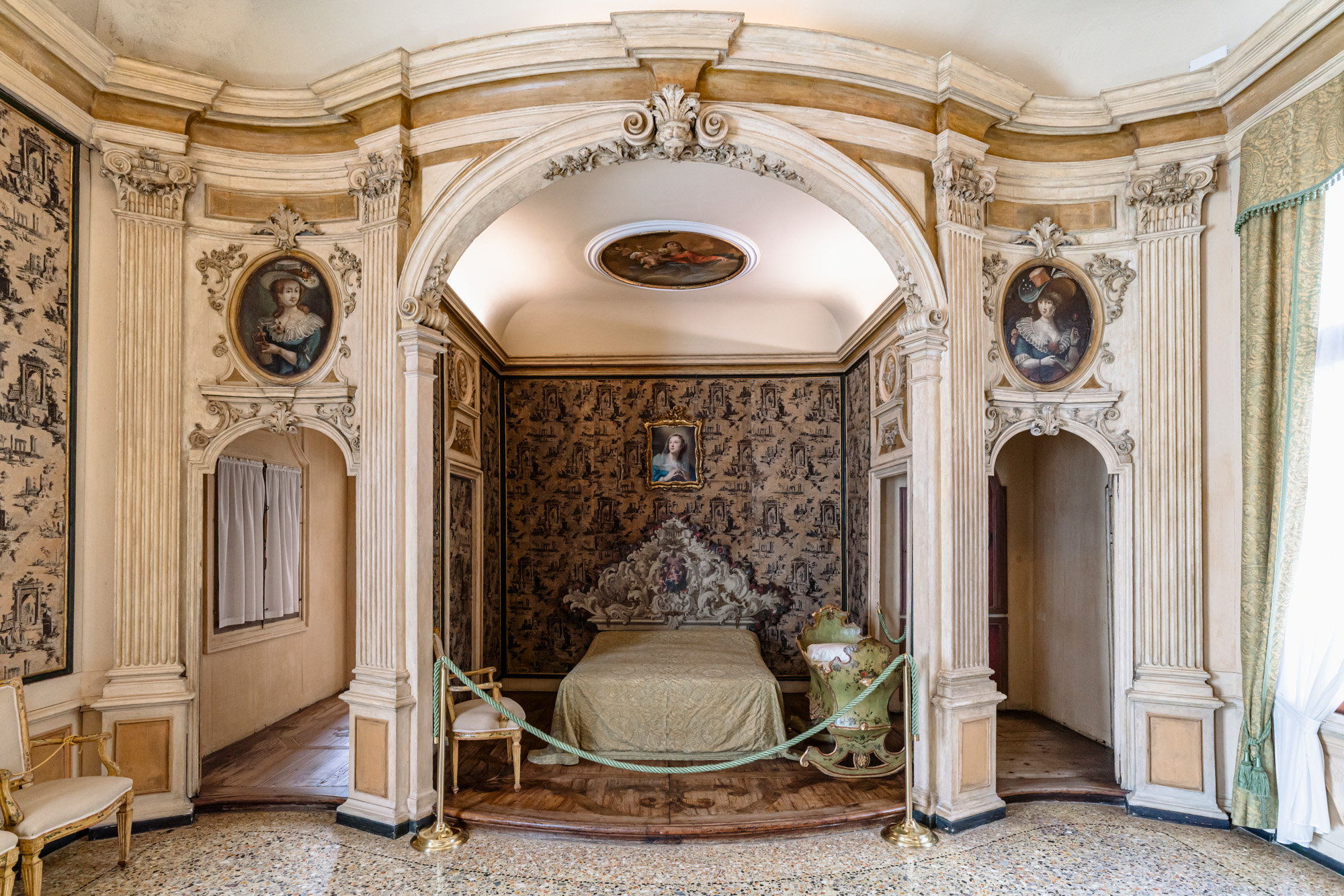
Alcove
The Alcove is the most intimate and private space in Ca’ Rezzonico: a faithful reconstruction of an eighteenth-century aristocratic bedchamber, complete with wardrobe and boudoir, from Palazzo Carminati at San Stae. The bed is enclosed within a refined carved and ivory-lacquered wooden structure; the painted headboard features a Holy Family with Saint Anne and young St John at its centre. Above the bed hangs a pastel Madonna by Rosalba Carriera, datable to the second half of the 1720s.
The furnishings include a walnut bureau-trumeau with Lombard-style marquetry inlays and a green lacquered cradle with polychrome flowers. In a display case, the sumptuous dressing set in gilded silver and green onyx, commissioned in 1752 from Augsburg silversmiths for the wedding of Cattaruzza Grimani and Pietro Vettor Pisani: 58 pieces containing everything a lady of rank might require, from a table mirror to a powder puff, from perfume bottles to writing implements.
Walls hung with eighteenth-century wallpaper decorated with small printed landscapes retouched by hand, lead finally into the boudoir, with its original period stucco decoration and paintings by Costantino Cedini.