First floor
Ballroom
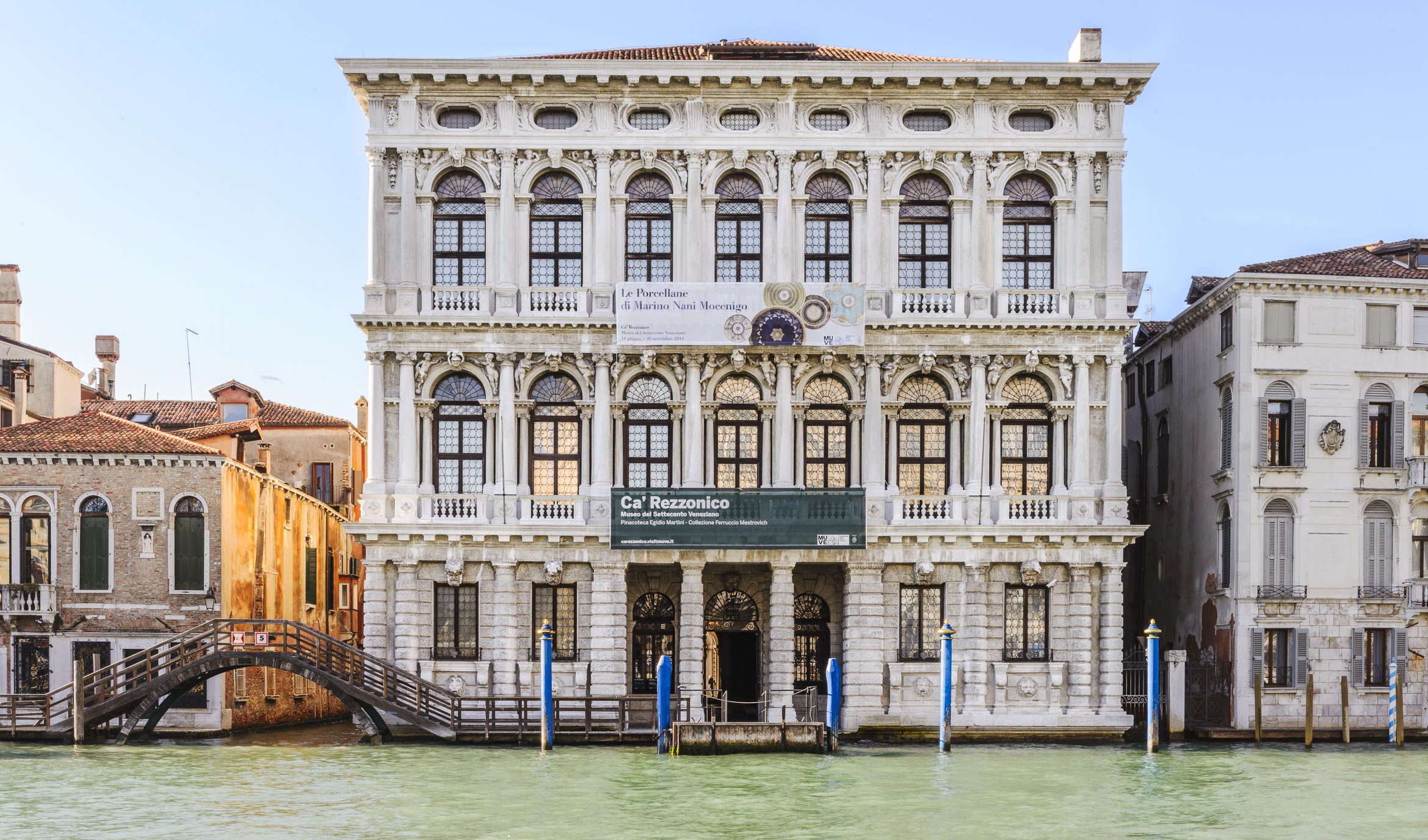
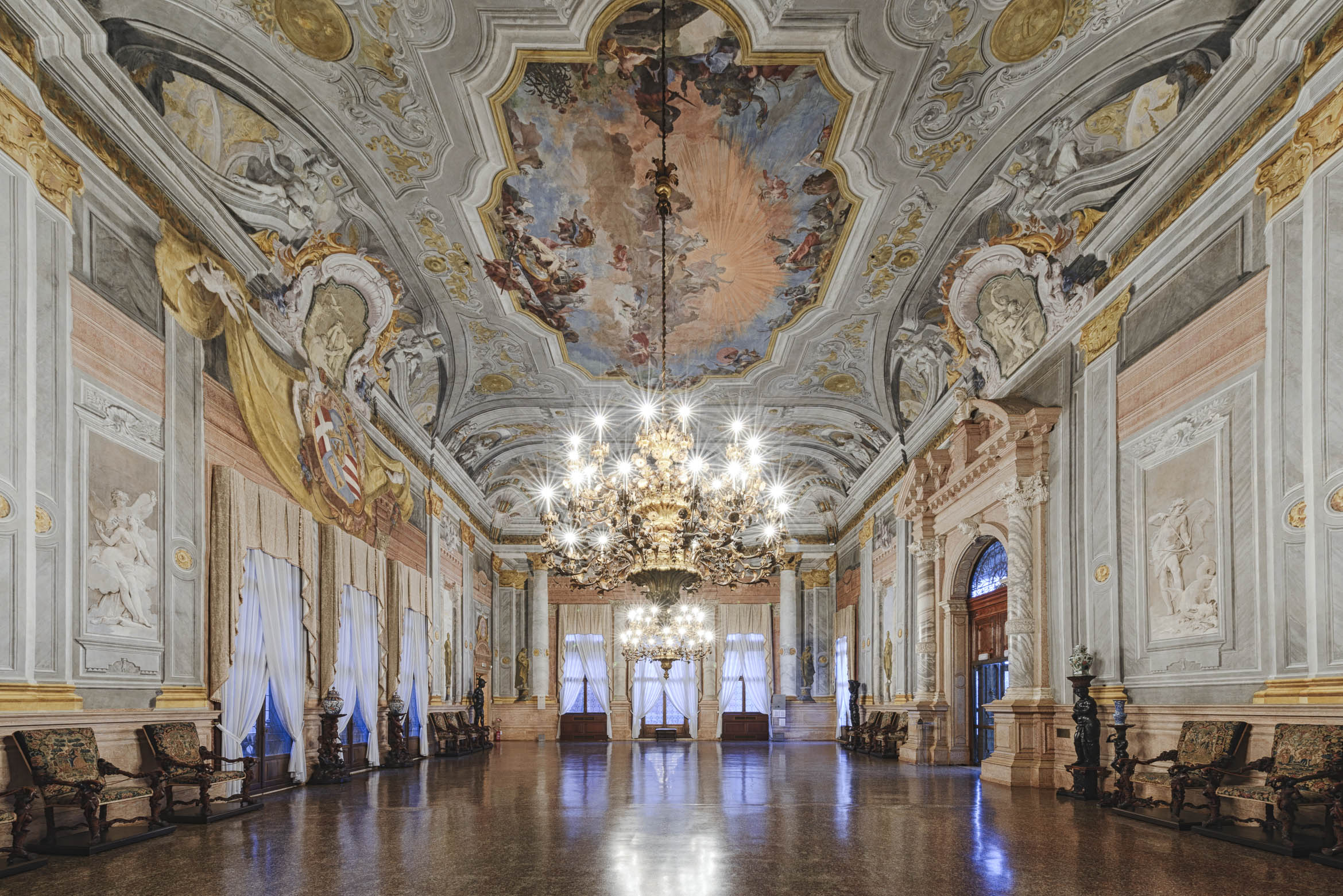
Beyond the monumental staircase lies the Ballroom, an environment unrivalled in Venice for its sheer scale and magnificence.
The frescoes, completed in 1751, are the work of Giambattista Crosato, alongside Girolamo Mengozzi Colonna, whose spectacular illusionistic architecture opens the room towards painted loggias. At the centre of the ceiling, Apollo triumphs on his chariot, surrounded by allegories of the four parts of the world, an auspicious wish of prosperity for the Rezzonico family, whose monumental heraldic coat of arms dominates the entrance wall.
Of the original furnishings, the imposing gilded wooden chandeliers survive. Along the walls, a remarkable selection of Baroque woodcarving masterpieces: the sumptuous ebony and boxwood furniture by Andrea Brustolon, described by Balzac as “the Michelangelo of wood”. Originally conceived for Palazzo Venier, these throne-chairs and ornamental figures, Interlaced branches, telamons, enslaved figures and Ethiopian warriors, transform the furniture into an exuberant sculptural celebration of Venetian eighteenth-century fantasy.
To protect the museum’s collections, the Ballroom is currently undergoing an extensive restoration.
Find out more >
Nuptial Allegory Room
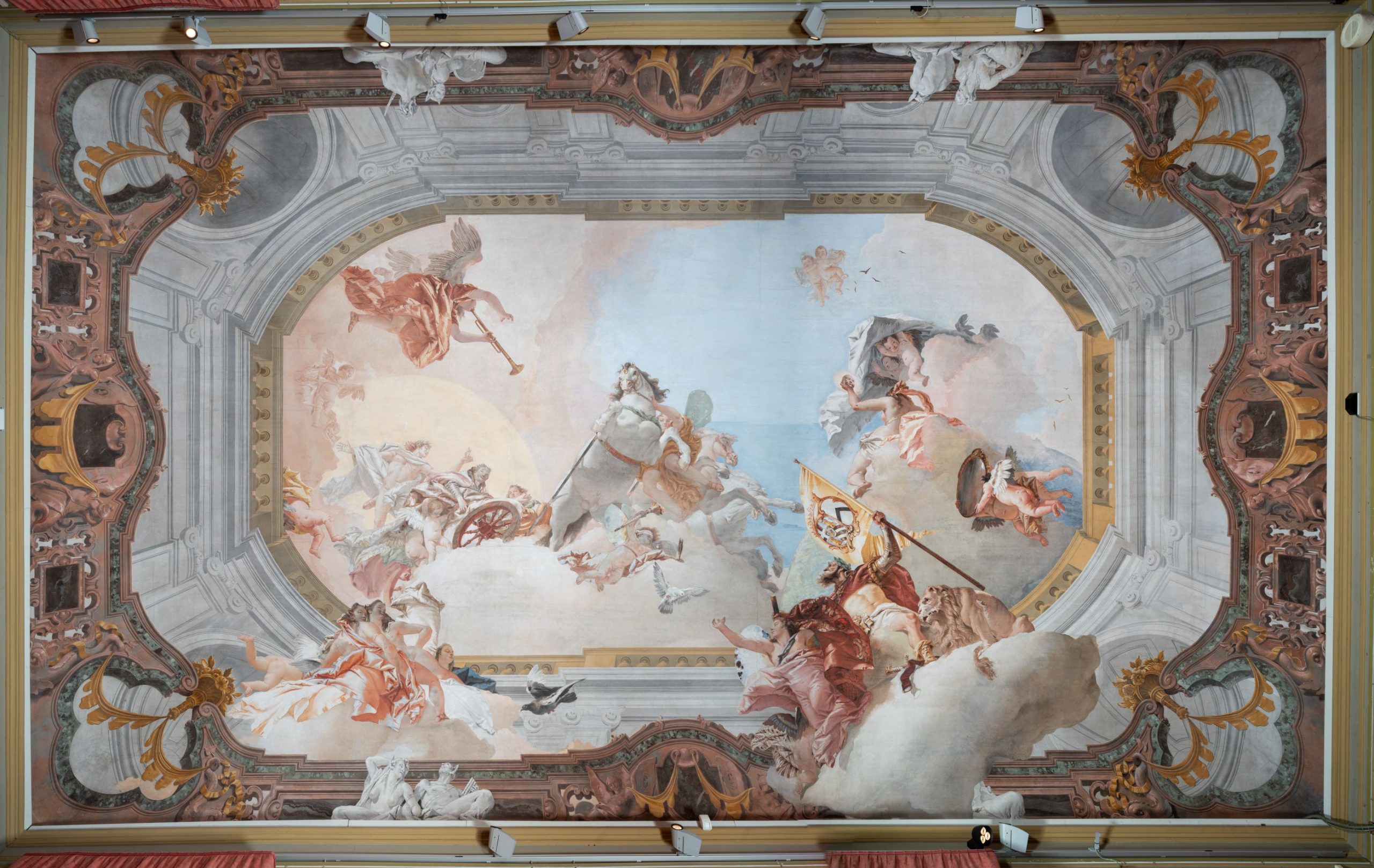
In the winter of 1757, to celebrate the wedding of Ludovico Rezzonico and Faustina Savorgnan, Giambattista Tiepolo painted his magnificent Nuptial Allegory on the ceiling of this room. Assisted by the fictive architectures of Girolamo Mengozzi Colonna and the satyrs executed by his son Giandomenico, Tiepolo conceived a space of extraordinary illusionistic dynamism. The bridal couple appears to the viewer aboard Apollo’s chariot, preceded by Cupid, while allegorical figures surround the central group: through a masterly use of multiple viewpoints, the painter renders this triumphant apparition from the sky utterly convincing.
The room, originally intended as the spouses’ reception apartment, holds further testimony to eighteenth-century taste. On the central wall hangs the portrait of Procurator Francesco Falier, by Bernardo Castelli (1786). To the right, an elegant hanging chapel overlooks the Rio di San Barnaba, its rococo interior of gilded stucco housing a small altarpiece with the Madonna and Saints by Francesco Zugno, a pupil of Tiepolo. Display cases along the walls present a collection of European porcelain from the Marino Nani Mocenigo collection.
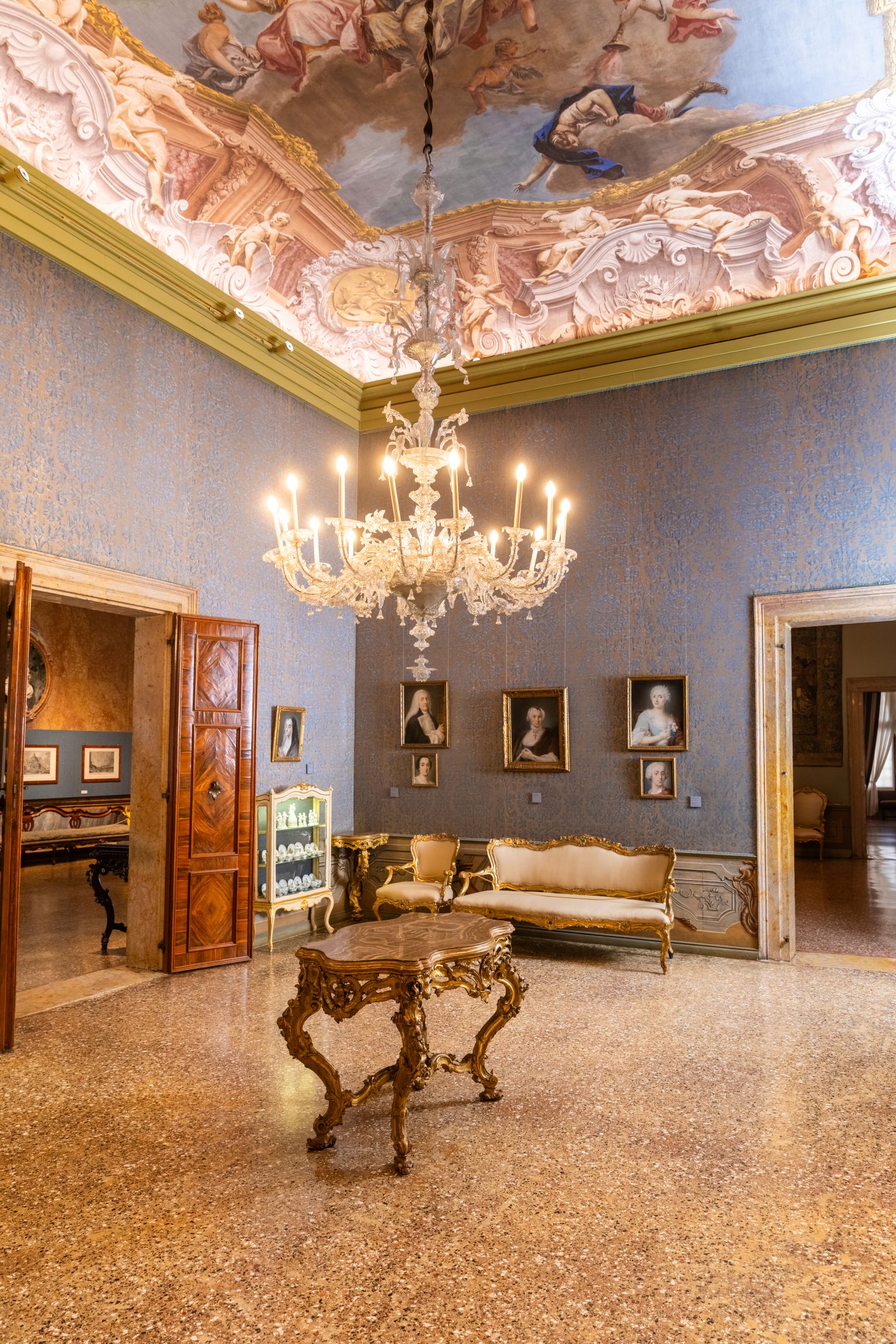
Pastel Room
The ceiling of the room features The Triumph of the Arts over Ignorance by Gaspare Diziani, a warm-toned fresco celebrating Venetian cultural supremacy at the mid-eighteenth century.
The true heart of the room, however, is its exceptional collection of pastel portraits. Pastel reached its peak in the eighteenth century, prized for its soft, powdery consistency, uniquely suited to capturing the luminosity of human skin. Its undisputed master was the Venetian Rosalba Carriera, the most celebrated Italian artist in Europe of her time. The works displayed here reveal an extraordinary psychological insight, evident in the contrasting emotional registers: from the resolute gaze of the Portrait of a Gentleman in Red, to the serene spirituality of Sister Maria Caterina Puppi, to the worldly vivacity of the celebrated contralto Faustina Bordoni Hasse.
Also on display is a fine portrait by Lorenzo Tiepolo, painted when the artist was just twenty-one, depicting his mother Cecilia Guardi, wife of Giambattista Tiepolo and sister of Antonio and Francesco Guardi. The room is completed by the Nani Mocenigo collection of porcelain, including a refined Meissen service decorated in gold on a blue background.
Tapestry Room
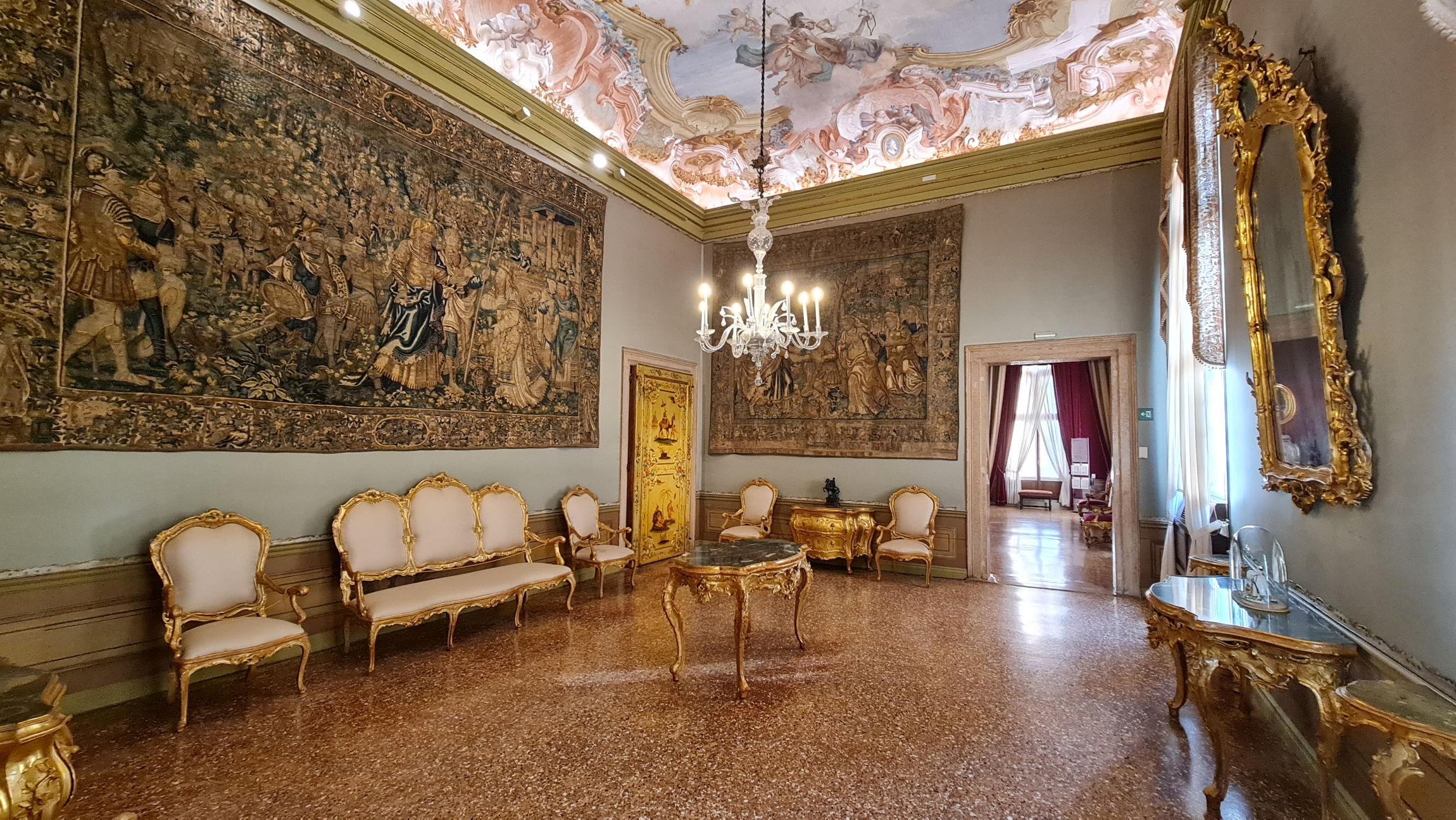
The room takes its name from the three magnificent sixteenth-century Flemish wall-tapestries adorning its walls, depicting episodes from the story of Solomon and the Queen of Sheba.
The room also documents a pivotal stylistic shift in eighteenth-century Venetian painting. On the ceiling, The Triumph of Virtues (1757–1758) by Jacopo Guarana marks a clear departure from Tiepolo’s theatricality: forsaking bold foreshortening in favour of a calm, single-plane composition in subdued tones, framed by decorative quadratura by Piero Visconti.
The furnishings represent one of the finest expressions of mature Venetian rococo. Outstanding is the salon suite from Palazzo Balbi Valier, its sinuous lines imitating the asymmetry of shells and sea foam. The room also preserves two wooden sculptures by Andrea Brustolon and an exceptional survivor: the lacquered door with chinoiserie decoration (c. 1760). The only original furnishing element remaining from the palazzo’s interior, it testifies to the era’s passion for the exotic and may, according to some scholars, have been designed by the Tiepolo family.
Throne Room
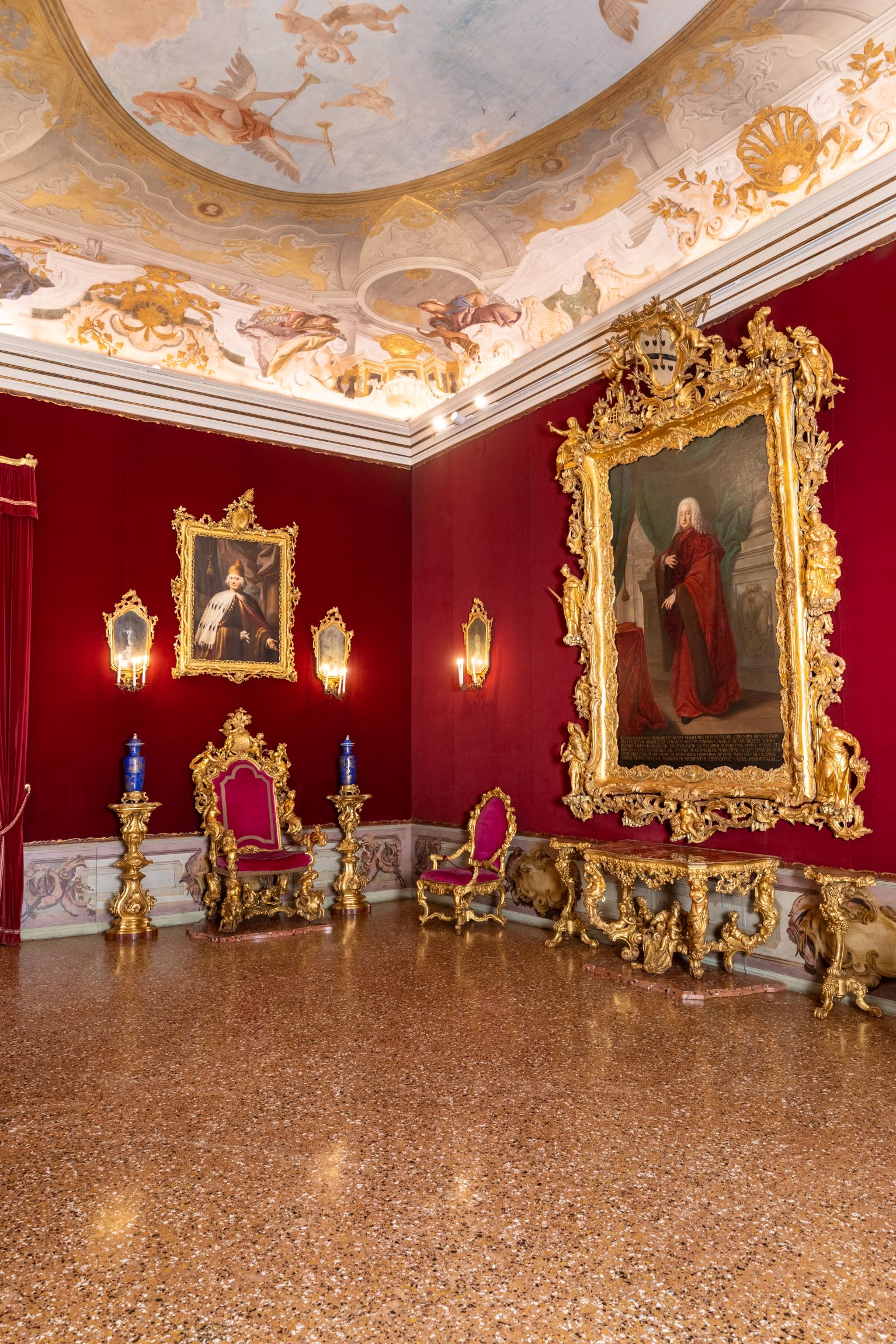
The Throne Room, lined in precious red velvet, takes its name from the magnificent gilded wooden seat that dominates the space, decorated with cherubs, nereids and sea horses. Crafted in the early decades of the eighteenth century in a style that lightens the exuberance of Brustolon with more graceful gilding, the throne entered history as the seat of Pope Pius VI during his stay in Venice in 1782.
The room represents the culmination of the wedding couple’s apartment and celebrates the family’s political ascent. On the ceiling, Giambattista Tiepolo and Girolamo Mengozzi Colonna frescoed the Allegory of Merit. Among the winged figures, one detail stands out: a putto holds the Libro d’Oro, the Golden Book of Venetian nobility, in which the Rezzonico secured their inscription in 1687.
The surrounding furnishings document the transition from the grandiloquence of the Baroque towards more refined workmanship. A prime example is the imposing gilded frame, richly decorated with allegorical figures, enclosing the portrait of the patrician Pietro Barbarigo by Bernardino Castelli. A refined console table and four chairs of the highest Venetian cabinetmaking complete the room.
Tiepolo Room
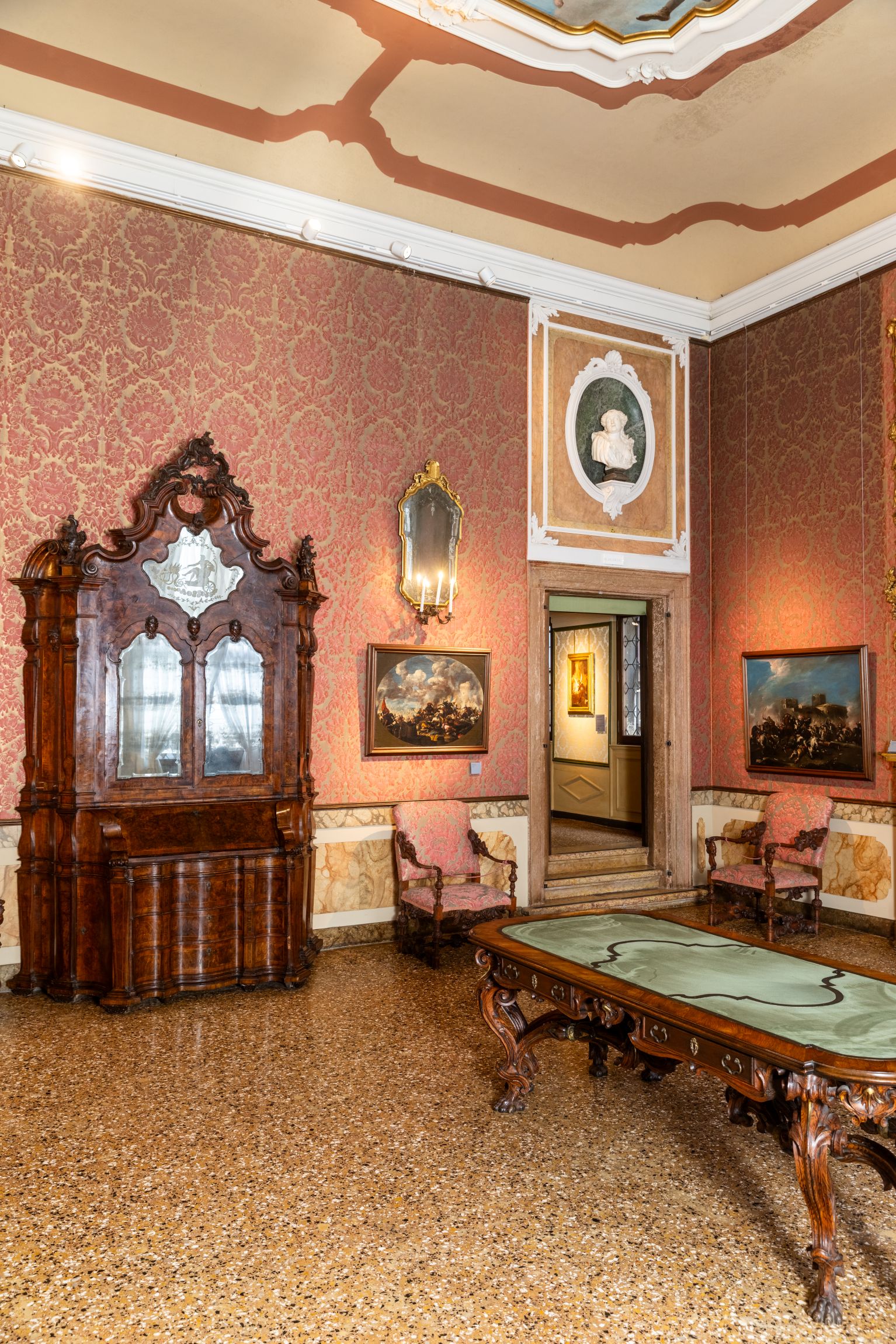
The room takes its name from its spectacular ceiling painting: Nobility and Virtue defeating Wickedness (1744–1745). Unlike the frescoes in the other rooms, this work was not originally part of Ca’ Rezzonico, but was acquired by the City of Venice in 1934. Tiepolo here reinterprets the legacy of Veronese with a brilliantly luminous palette, dominated by silvery-grey harmonies and the iridescent orange of Virtue, enriched by the detail of the page, perhaps a portrait of the painter’s own son.
On the walls, the Portrait of the Architect Bartolomeo Ferracina by Alessandro Longhi stands out as a masterpiece of Venetian portraiture. The room’s furnishings are of exceptional quality: at its centre, a monumental eight-legged baroque gaming table with lion-paw feet, surrounded by boxwood chairs from the workshop of Andrea Brustolon. The room’s true unicum, however, is the imposing eighteenth-century bureau-trumeau in walnut root veneer, unrivalled in Venetian cabinetmaking for its dimensions and state of preservation.
Library
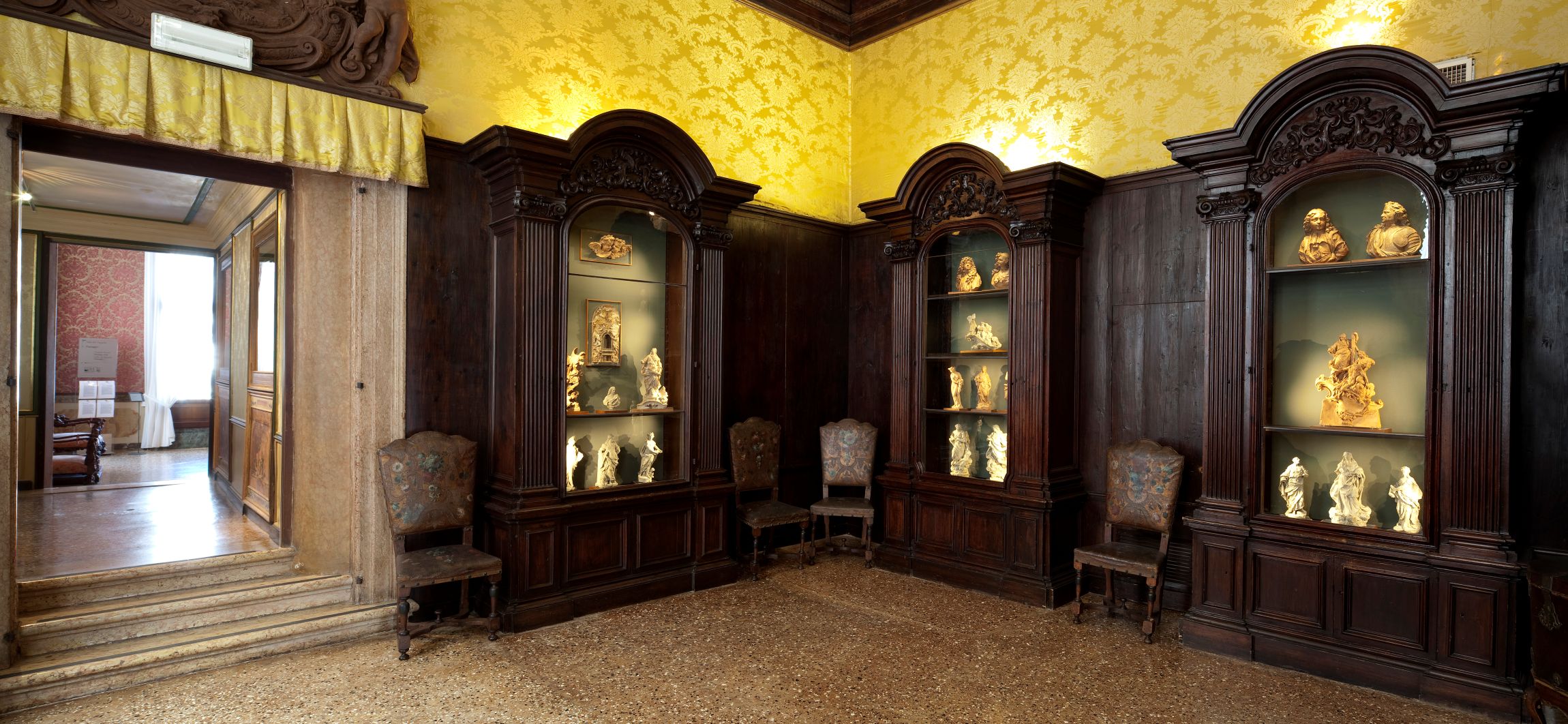
The Library’s seventeenth-century walnut cabinets house an unexpected treasure: the studio collection of sculptor Giovanni Maria Morlaiter.
This assemblage of terracotta and unfired clay sketches documents the entire eighteenth-century creative process, from first preparatory studies to the highly finished presentation models submitted to clients for final approval. In these works, Morlaiter translates into three dimensions the luminous vibrancy of contemporary Venetian painting. The pieces on display range from sacred sculpture to garden statues, and include one object that speaks directly to the building itself: the model for the mascaron still visible today in the courtyard of Ca’ Rezzonico.
The display also includes models by other masters who passed through the studio, among them Enrico Merengo and Giusto Le Court, the so-called “Adriatic Bernini”. Above the room, the ceiling is decorated with a shaped canvas depicting the Allegory of Merit, painted by Mattia Bortoloni.
Lazzarini Room
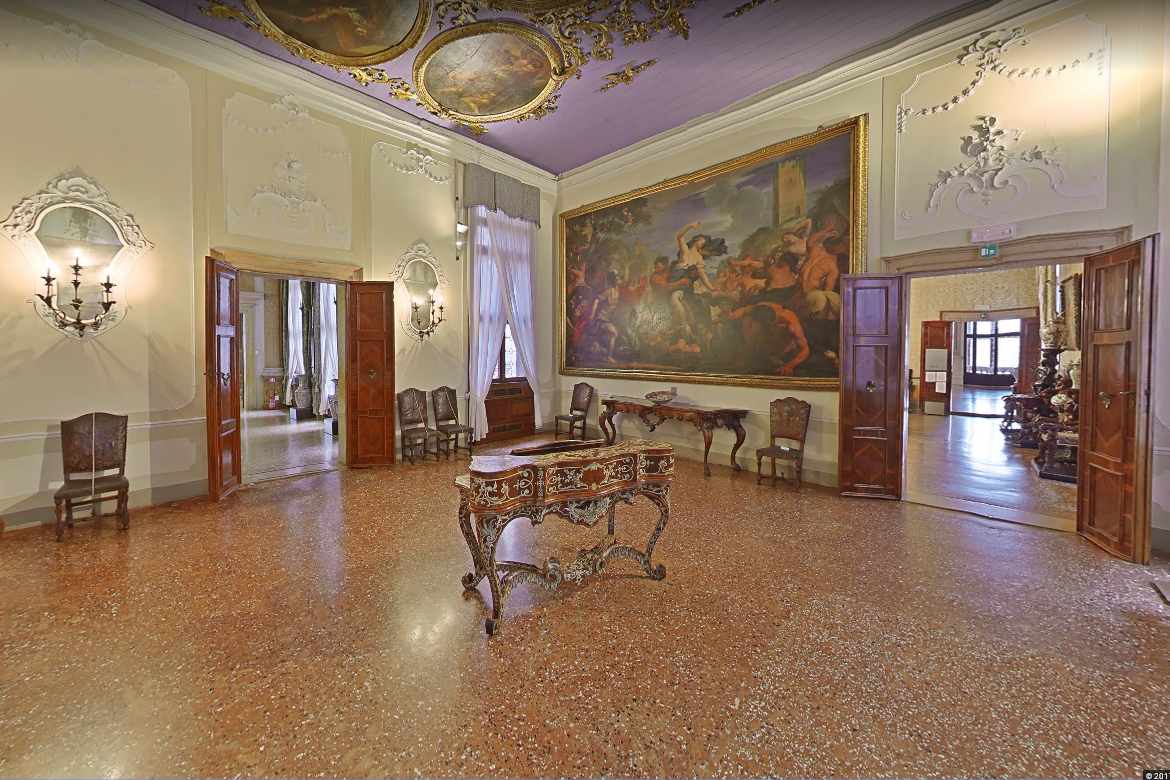
The room houses three imposing late seventeenth-century mythological canvases, baroque masterpieces by Antonio Molinari, Antonio Bellucci and Gregorio Lazzarini. Commissioned by the procurator Vettòre Correr for the main reception room of his palazzo, the works stage the tumult of human passion and excess, as in Orpheus torn apart by the Bacchantes, serving as a sophisticated, ironic invitation to temperance for those dining beneath them.
In sharp formal contrast, the ceiling, a series of canvases set within carved frames, transferred here in 1936 from Palazzo Nani, reflects the decorative taste of the late seventeenth century, predating the great era of fresco. The five mythological ovals, dominated by the figure of Prometheus, display the unconventional and inventive brushwork of the Vicenza-born Francesco Maffei, far removed from the formal rigour of his younger contemporaries on the walls below.
In the centre of the room stands a splendid writing-desk veneered in precious woods, with carved ivory inlays and gilded bronze rods. This is the work of the famous Turin cabinet-maker Pietro Piffetti, signed and dated 1741.
Brustolon Room
The room takes its name from the monumental fornimento, a complete suite of furnishings, as it is known in Venetian, carved in wood by Andrea Brustolon for the Venier family, considered the absolute pinnacle of Venetian woodcarving of the early eighteenth century. The centrepiece of the suite is the celebrated vase-stand console: Hercules, having vanquished the Hydra of Lerna and Cerberus at his feet, supports a rough-hewn surface on which three ebony blackamoors in chains hold a great vase, while two reclining bearded old men at the sides each support two further vases. This extraordinary sculptural virtuosity, extended throughout the Moorish vase-bearers and the allegories of the Four Seasons and Four Elements, was conceived as a lavish display stand for the Venier family’s precious collection of Chinese and Japanese vases.
At the centre of the room, the eye is drawn to the breathtaking twenty-flame chandelier by the celebrated Murano glassmaker Giuseppe Briati, produced around the mid-eighteenth century: a triumph of Murano crystal and polychrome glass paste, miraculously preserved intact.
The room is completed by eleven seventeenth-century mythological canvases by Francesco Maffei and four monochrome roundels depicting the continents by Francesco Polazzo – both cycles, from different periods, originally adorning the ceilings of Palazzo Nani.
Portego
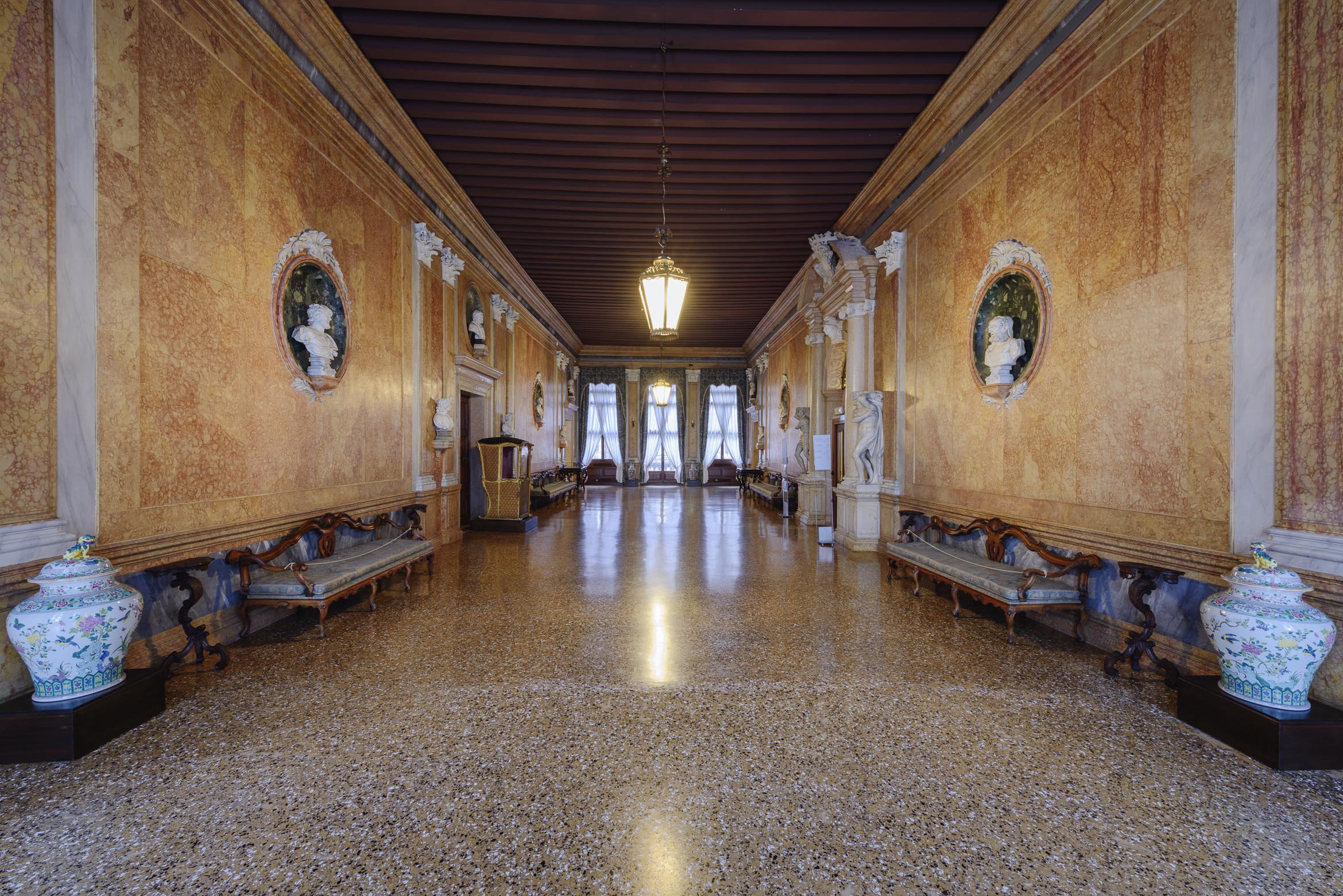
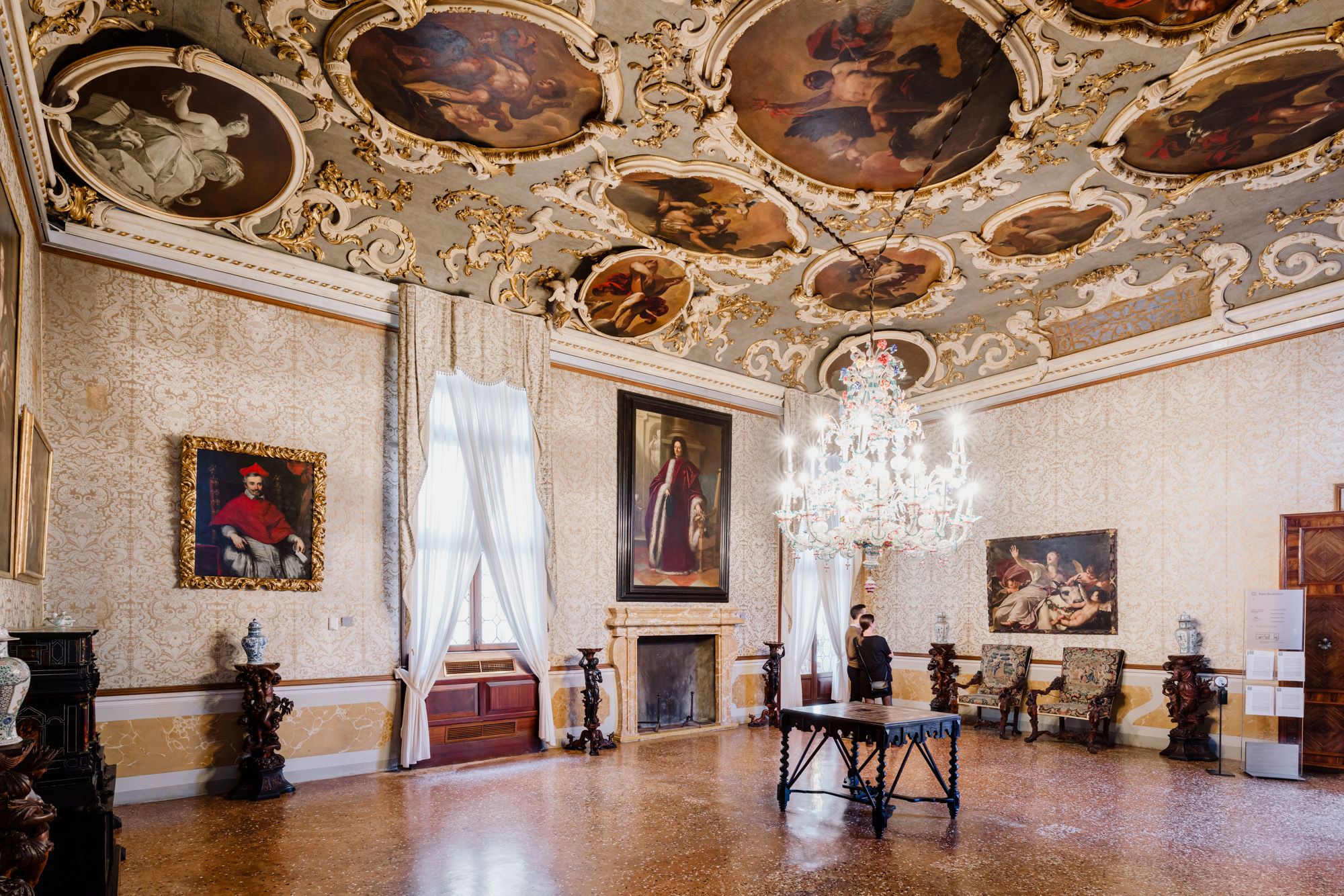
The portego – the traditional Venetian reception hall – serves here as an architectural connector between the rooms, its representative function entirely absorbed by the Ballroom. Faced in warm pink marmorino, the space is furnished with rocaille sofas and an elegant gilded sedan chair, compensating for the nineteenth-century dispersal of the original canvases by Luca Giordano with a superb display of sculpture and decorative arts.
In the niches and on the brackets, allegorical busts of great psychological force stand out: among them, the unsettling Envy by Giusto Le Court, a high point of raw Baroque naturalism, and the languorous Lucretia by the Genoese sculptor Filippo Parodi. Flanking the portal, two imposing sixteenth-century telamons by Alessandro Vittoria, once supports of a monumental fireplace, stand guard.
The room is further enriched by two large seventeenth-century pier tables, masterpieces of pietre dure marquetry by Benedetto Corbarelli, created for Bishop Francesco Pisani of the Moretta branch. Their virtuoso central medallions, dedicated to Orpheus and the Phoenix, are set within a dense weave of branches, colourful birds and miniature scenes from Aesop’s fables, a testament to a level of craftsmanship of the rarest perfection.